
You cannot order exact-fit replacement cushions without knowing which Lowe’s set you own — and Lowe’s makes you work for it. This guide walks through where the model number hides on Lowe’s patio furniture, how to decode the label structure (including which “brands” are actually Lowe’s private labels), and the fallback methods when tags and receipts are gone. The reward for identification: cushions cut to your frame’s real dimensions instead of the universal-fit guessing game covered in our Lowe’s cushions guide.
Why Lowe’s Identification Is Harder Than Home Depot
Home Depot concentrates outdoor furniture under one house brand (Hampton Bay — see our Hampton Bay model guide). Lowe’s spreads outdoor furniture across:
- – Private labels — Allen + Roth being the big one, spanning dozens of categories beyond patio.
- – Exclusive-name manufacturer brands — e.g., Hanover sets sold through Lowe’s, where the manufacturer brand matters more than the retailer.
- – Seasonal imports — one-season sets with generic names like “5-Piece Wicker Conversation Set” that never establish a durable line name.
So step one is not finding a number — it is figuring out whose number you are looking for.
Where to Find the Model Number on Lowe’s Furniture
Check in this order:
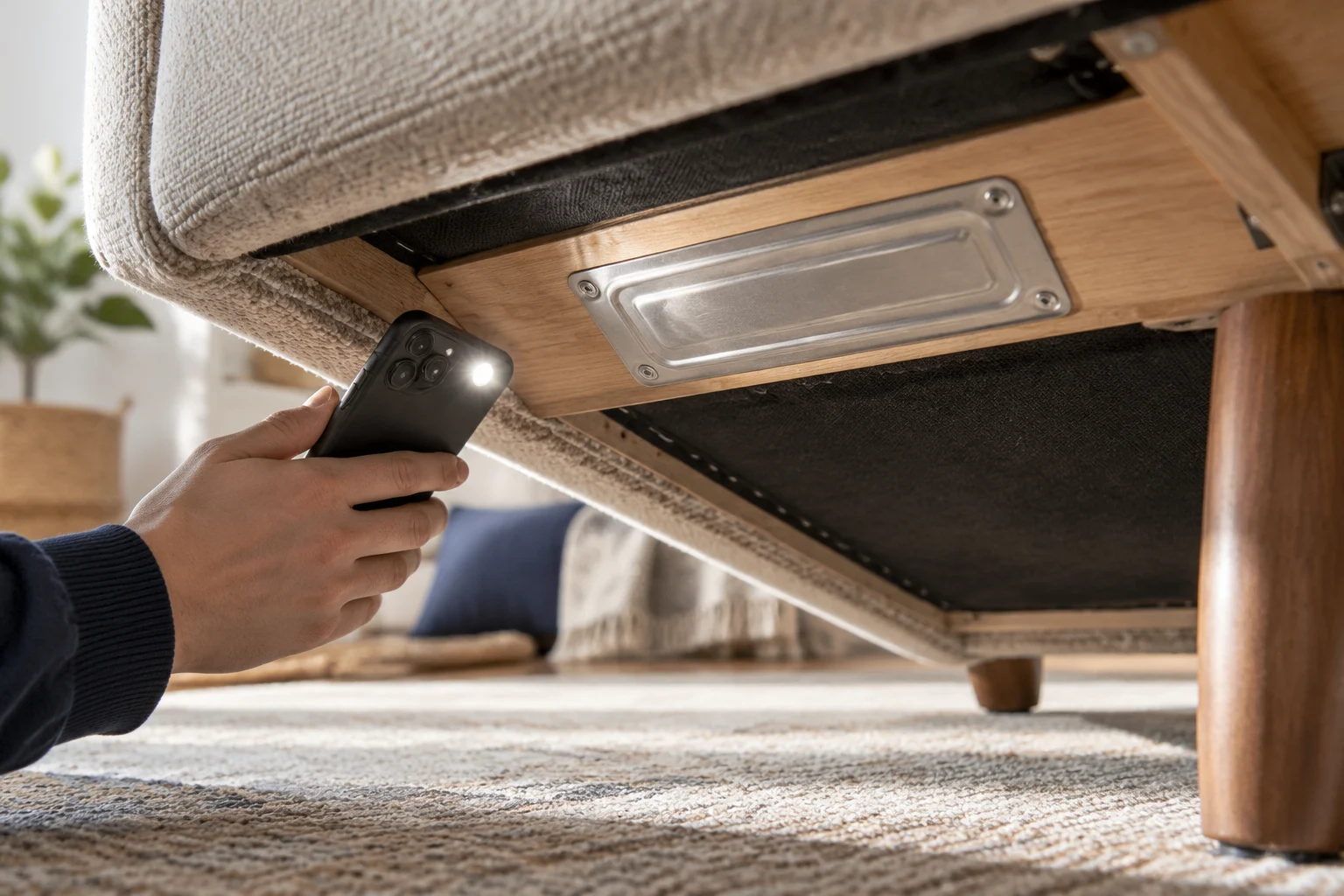
1. The frame tag or sticker
Look for a paper/plastic tag or adhesive label on the frame — under the seat deck, on the bottom of a chair rail, or behind the back frame. Lowe’s sets typically carry a manufacturer tag with a model or item number, often alongside a date code. On wicker sets the tag is frequently zip-tied to the base frame where you cannot see it standing up; flip a chair.
2. The assembly manual
The manual cover or first page carries the model number and usually the set name. If you kept the box, the shipping label repeats it. Lowe’s manuals are also downloadable from the product page if the set is still listed — search “site:lowes.com” plus your set’s descriptive words.
3. Your Lowe’s receipt or MyLowe’s account
The strongest method for anything bought in the last several years. MyLowe’s (Lowe’s loyalty program) keeps purchase history against your phone number — walk into a service desk or log in, and the order record contains the exact item number and product name. Credit card + approximate date also lets in-store service pull the transaction. The item number maps to a product page, which names the line.
4. The product URL or listing you saved
Lowes.com product URLs contain a numeric item ID. If you ever saved, shared, or wishlisted the listing, that number identifies the set even after the listing is retired (search the number directly).
5. Manufacturer marks
For Hanover and similar manufacturer-branded sets, the maker’s name and model are often stamped or molded into the frame underside or printed on a riveted plate. Manufacturer model numbers are more stable than Lowe’s SKU numbering — Hanover’s own parts channel (still active for current models) keys off them.
How to Decode What You Found
- – Lowe’s item numbers (typically 6-8 digits): paste into Google or lowes.com search. Live listing = set name in the title. Dead listing = try the number on eBay and manufacturer sites.
- – Allen + Roth: this is Lowe’s private design label, not a manufacturer. “Allen + Roth” alone identifies nothing dimension-wise — you need the specific set name/model beneath it (e.g., “Allen + Roth Groveport 5-Piece”). Treat it exactly like a Hampton Bay series name: the specific model carries the cushion spec.
- – Hanover (or other maker) model: search the manufacturer’s site directly; makers often publish spec sheets with cushion dimensions that Lowe’s pages omit.
- – Date codes: a four-digit stamp like “0521” usually reads as month/year of manufacture — useful for narrowing which version of a multi-year line you own.
No Tag, No Receipt: The Fallback Ladder
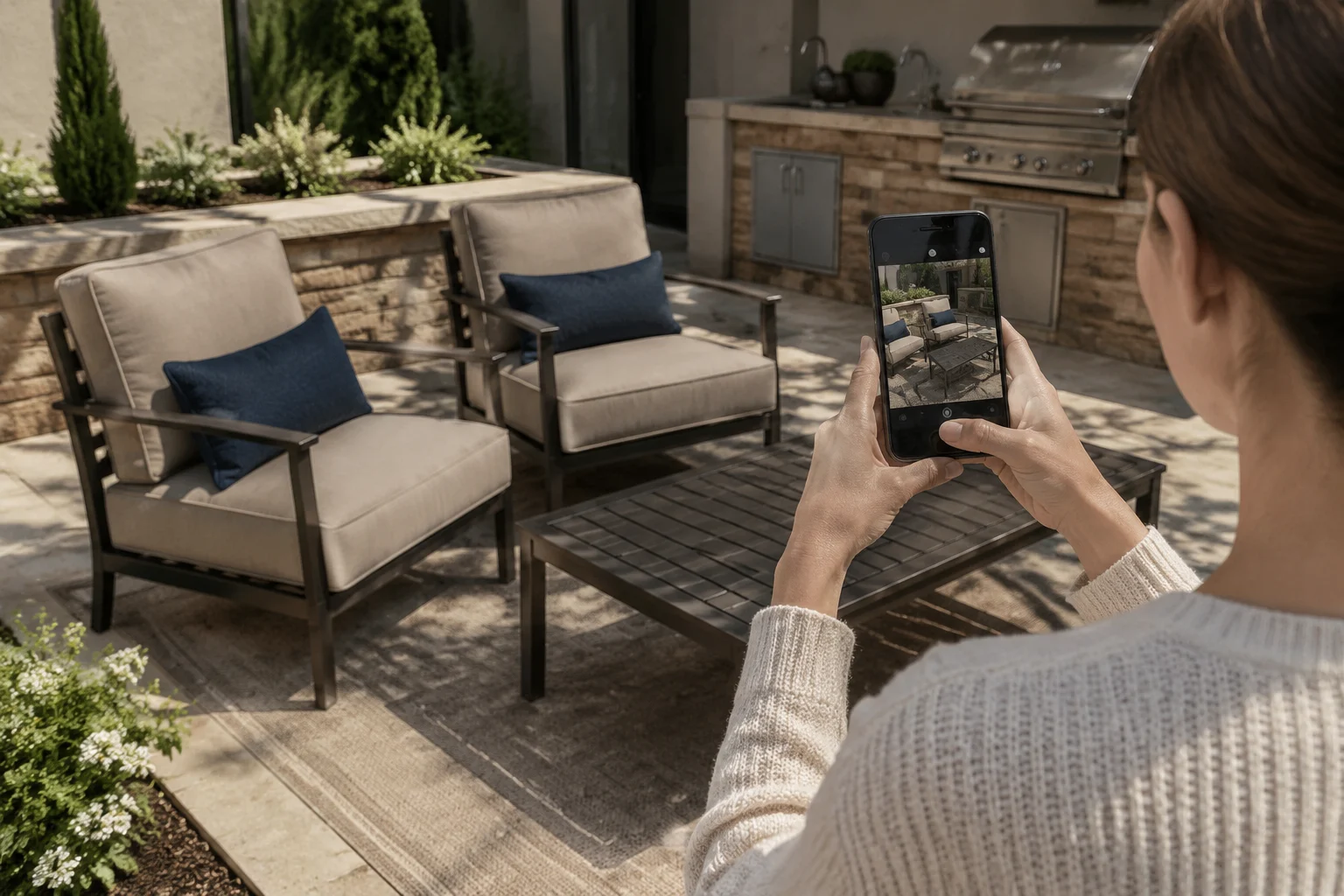
- Reverse image search. Photograph the set straight-on in daylight and run Google Images / Lens against “Lowe’s patio set” plus distinctive features (arm shape, weave color, frame style). Archived product photos, Pinterest pins, and review photos circulate for years after delisting.
- Dimension matching against published specs. Measure one seat cushion — width x depth x thickness, seam to seam (method here) — and compare against documented patterns. This is how unidentified sets get identified in practice: the dimension fingerprint narrows candidates fast.
- Owner communities. Reddit (r/patio, r/furniture) and garden-web style forums identify sets from photos routinely, often within hours, and someone usually owns the same set and knows its cushions.
- Call it what it is and go custom. If the set stays anonymous after steps 1-3, identification stops mattering: a custom workshop cuts to your measurements regardless of lineage. Custom cushions needs only numbers, not names.
One Documented Trap: Same Name, Different Furniture
Brand-name collision is real in this market, and it burns people ordering “matching” cushions by name alone. The documented case from our brand research: Lowe’s sold a “Mill Valley” patio set manufactured by Pacific Casual — while a completely different “Mill Valley” series exists in another retailer’s lineup with different dimensions. Same name, different frames, incompatible cushions. The lesson generalizes: never order by line name from memory; verify the name belongs to your retailer-era set, or skip straight to measurements.
What to Do Once You’ve Identified the Set
- Current model? Check Lowe’s product page accessories tab for matching replacement cushions, and check the manufacturer’s own parts channel (Hanover notably keeps spares for active models).
- Discontinued? Your routes are stock-universal (works only for standard-square dining seats — see the fit table in our Lowe’s cushions guide), salvage listings, or custom.
- Either way, record the identification somewhere physical: write the model number on the frame underside with a paint pen. Future-you, ordering cushions in 2029, will be grateful.
Identification Worked Examples
Three common scenarios, worked end to end:
Example 1: “I bought it at Lowe’s three years ago, paid with a card.” Start at step 3 (receipt/account lookup). MyLowe’s history or in-store service with card-plus-date recovers the item number; the product page names the set. Total time: ten minutes. If the listing is dead, search the item number on the open web — aftermarket and salvage listings often carry the product name in their titles.
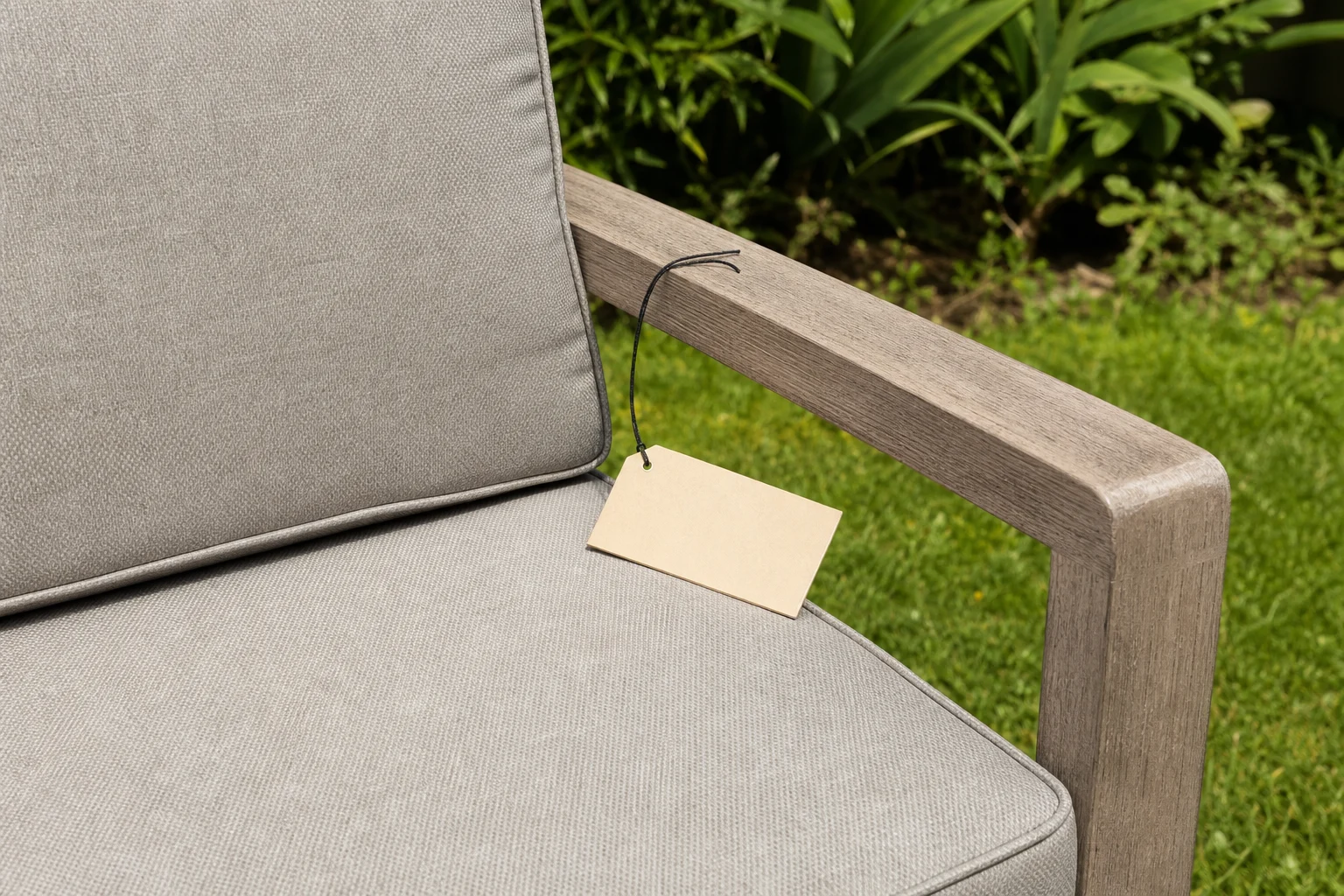
Example 2: “It was a gift, no receipt, there’s a tag but it’s weather-blank.” Partially readable tags usually surrender enough: even three legible characters of a model number plus the color narrows a web search decisively. Combine with the design-clue method — photograph the set straight-on, note the arm shape, weave pattern, frame color, and any distinctive hardware, then reverse-image-search against “Lowe’s patio” plus those terms.
Example 3: “No tag, no receipt, no idea — but I have one intact cushion.” Skip identification and go dimensional. Measure the surviving cushion (width x depth x thickness, seam to seam, method at how-to-measure), and take the numbers straight to custom outdoor cushions. Identification is a means, not an end; measurements achieve the same result with certainty.
Where Identification Ends and Measurement Wins
A principle worth stating plainly: the model number is only ever a key to dimensions. If the dimensions are already in your hands — from a surviving cushion, or from a spec table like our Home Depot house-lines chart (31 collections across Hampton Bay and Martha Stewart, 195+ verified sizes; chart) — the number itself adds nothing. Spend your effort where the information actually lives:
| You have | Fastest path to exact-fit cushions |
| Model number + live product page | Page spec table, or manufacturer parts channel |
| Model number + dead listing | Search the number on eBay/aftermarket; else measure |
| Series name only (e.g., “Allen + Roth something”) | Match against published dimension tables, or measure |
| Surviving cushions, no names | Measure them — done |
| Nothing but the frame | Measure the frame deck; a workshop derives the cushion spec |
Tools That Make This Easier
- – A tape measure and your phone camera: photograph every label you find, even blank-looking ones — zoom and contrast often recover characters invisible to the eye. Photograph the set from dead-front and both diagonals; those three shots carry enough geometry for forums and reverse-image search.
- – A paint pen: once identified, write the model on the frame underside. The cheapest insurance in furniture ownership.
- – Your email search bar: search your own inbox for the set’s likely purchase words (“patio,” “wicker,” “conversation set”) — order confirmations surface years later. This works for Lowe’s, Home Depot, Target, and Wayfair alike.
- – Saved-search alerts on marketplaces: once you have a model name, set eBay and Facebook Marketplace alerts for it. Salvage parts and even whole second sets surface on weekly cycles.
FAQ
Where is the model number on Lowe’s patio furniture?
On a frame tag or sticker under the seat deck or on the base frame (flip a chair for wicker sets), on the assembly manual cover, and in your MyLowe’s purchase history or receipt. Manufacturer-branded sets also carry maker’s marks on the frame underside.
What is Allen + Roth?
Lowe’s private design label, not a furniture manufacturer. The label alone tells you nothing about cushion dimensions — you need the specific set name and model beneath it, exactly like a Hampton Bay series name.
Can Lowe’s look up my purchase without a receipt?
Yes, in practice — MyLowe’s history tied to your phone number, or in-store service with the credit card and approximate date. The recovered order contains the item number and set name.
My Lowe’s set is discontinued and unlisted. How do I get exact-fit cushions?
Identify by photo/dimension matching (above), hunt salvage listings for the model name, or go straight to custom with your measurements — age and delisting are irrelevant to a made-to-order workshop. Start at custom cushions.
Do cushion sizes transfer between Lowe’s sets with the same look?
No. Visually similar wicker sets across seasons and manufacturers routinely differ by 2-4 inches in seat depth and width. Always measure — three numbers per cushion (width, depth, thickness) settle it permanently. Method: how to measure.
Patio Chair Cushions: The Complete Buying Guide (Outdoor Too)
Everything that decides a patio or outdoor chair cushion — sizes, thickness, ties, fabric tiers and where each buying route wins. Custom from $45 when grids fail.
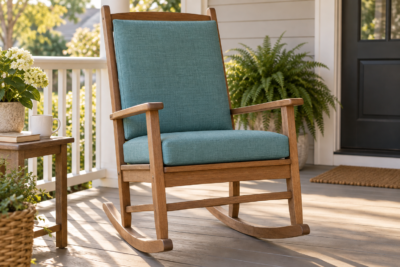
Outdoor Rocking Chair Cushions: The Weatherproof Guide to Sizes and Fabrics
An indoor rocking cushion dies fast on a porch. The sun bleaches the print in a single season, the foam
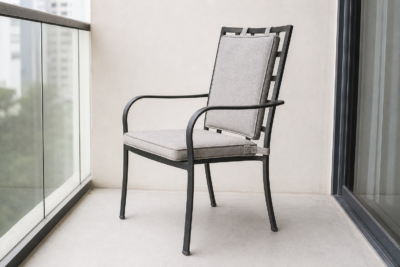
Cushions for Metal Patio Chairs: Frame Types, Grip and the Heat Question
Cushions for metal patio chairs guide: wrought iron, aluminum and steel frames and what each means for pads, sliding on slick metal, heat absorption in sun, sizing across mixed metal sets, and the outdoor duty spec.
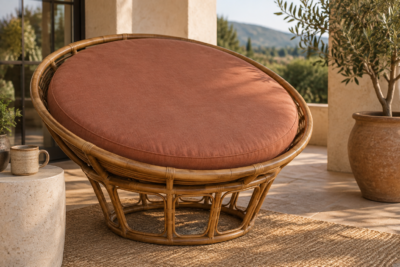
Outdoor Papasan Cushions: Weathering the Big Round
Outdoor papasan cushions fail in a known order — fabric, fill, bowl. The overhang-vs-inset diameter decision, fiber vs foam outdoors, and the honest line between a flat round and the concave original.
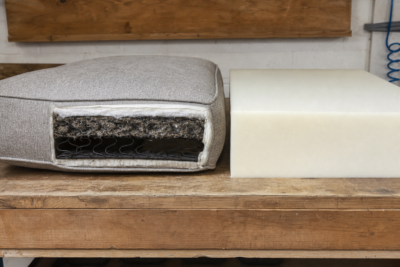
High Density Foam Couch Guide: What Density Actually Means
What high density foam actually means for a couch — the ×10 density convention, density vs firmness (ILD), the 35D–65D grades ranked by use, how each grade fails, and what density costs per square foot.
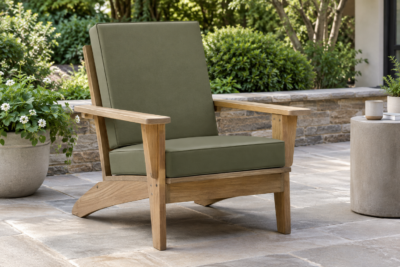
Adirondack Chair Cushions: Sizes, Selection & Replacement Guide
Adirondack cushion sizes decoded: 20×20 seats, tall-back options, tie patterns, best fabrics — plus fitting odd or vintage chairs.