
Charleston (Hampton Bay)
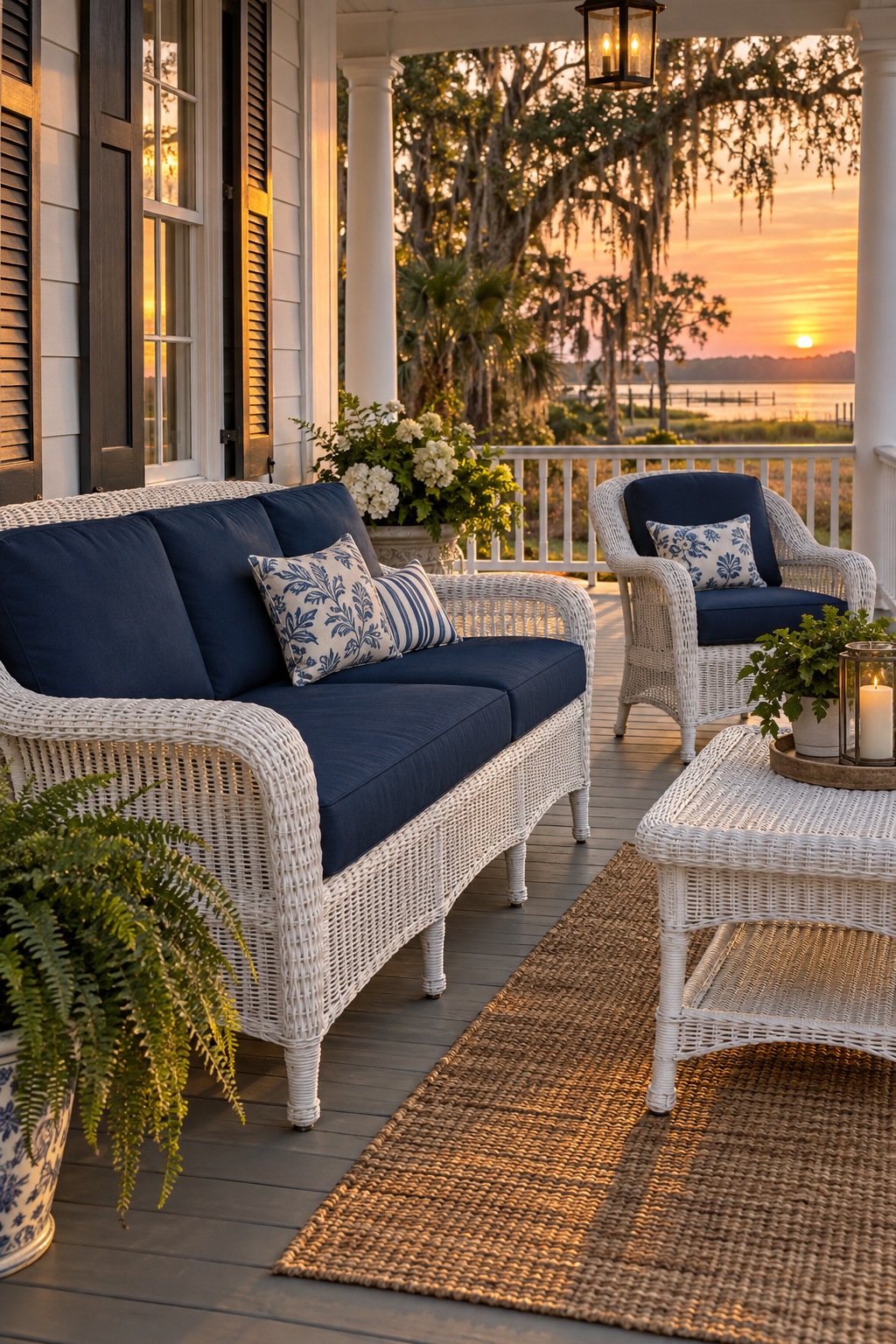
The Charleston set at the coast house gets its worst treatment in the weeks nobody is there to see it. A rental guest drags a dining chair across the deck, a storm blows sideways rain under the porch roof, and by the time you drive down in spring the covers have given up before the season even started. The rebuild has to happen in April — and you are four hundred miles inland until Memorial Day.
This is now a common shape of project: the furniture lives at the beach, the decisions happen at a kitchen table hundreds of miles away, and a cleaning crew with a phone camera stands in for your own tape measure. It works. It just needs a protocol.
A renovation run from four hundred miles inland
Remote is not a worse version of measuring — it is a different discipline with its own failure points. When you stand in front of a chair yourself, your hands catch most errors before they matter: the tape bows, you see it; the frame tapers, you feel it. Distance removes that feedback loop, so every figure has to be made to prove itself a second way before cloth gets cut.
The good news is what stays constant. Every cushion on this bench is cut to submitted figures, not to any Charleston chart — and no trustworthy Charleston chart exists anyway, which removes the temptation to skip the measuring and hope. The swatch menu holds 119 cloths, all starting from the same $45 make-base at a given size, so the fabric decision can safely be made last, from your own notes and photographs, once the numbers are locked.
Three ways to measure a chair you cannot sit on
- Mail one representative cushion both ways. Ask the caretaker to box the single most-used dining pad and ship it to you. A physical old cushion answers questions no figure captures — how the foam compressed, where the frame wore the cover, whether the old thickness felt right. You measure it at your own table, then ship it back or retire it. One round trip costs less than one remake.
- Run a scripted video measuring session. The caretaker holds the tape; you hold the checklist. This is not a casual FaceTime — the next section gives the script.
- Calibrate photographs with a known object. A dollar bill is exactly 6.14 inches long; a credit card is 3.37. One laid flat on the seat deck, in the same plane as the measurement, turns any photo into a checkable scale — a way to audit figures you could not take yourself.
Most remote projects use all three. The mailed cushion anchors thickness and feel, the video session produces the live figures, and the scaled photograph catches whatever the tape missed.
The video measuring session, run like a checklist
Sessions fail in predictable ways, so the script exists to prevent each one. Ask for daylight — porch lights turn navy fabric black and hide the tape graduations. Ask the camera to stay on the number an extra breath after reading it; half the errors in remote figures are transcribed from a moving frame. And insist on the read-back ritual: the person measuring says the figure aloud, you repeat it, they confirm against the tape. It feels excessive for the first two cushions and indispensable by the fifth.
One practical note on tools: a wide, rigid tape measure reads truer on outdoor frames than a limp pocket tape, which sags across a 24-inch seat and quietly steals an eighth of an inch. If the caretaker owns only a soft tape, the scaled-photograph method becomes your safety net for every width above twenty inches.
Making the numbers prove themselves
Before any order leaves your kitchen table, each critical dimension should exist twice, from two different sources. The frame width from the video session, checked against the photograph scaled off the credit card. The seat depth from the caretaker’s tape, checked against the same figure on the mailed cushion. Where two sources agree within a sixteenth or an eighth, you can trust either. Where they diverge by a quarter inch or more, something moved — tape sag, a photo taken at an angle, a frame corner that is not square — and that piece gets re-measured, not averaged.
Averaging two disagreeing figures is the classic remote-project mistake. The average of a good number and a bad number is a bad number.
Spending the tolerance before someone else does
Every build here carries a cutting tolerance of ±½″, widening to ±¾″ past 36″, with anything outside remade at no charge. On a remote order that tolerance is not fine print — it is a budget you should spend deliberately. When two credible width figures differ slightly, submitting the larger one leans the fit toward snug; the smaller leans toward a cushion that can be centered with a finger’s slack. Neither is wrong, but decide on purpose, because the chair cannot be glanced at before the truck leaves.
The same arithmetic explains why remote projects should order one complete chair first when the schedule allows it. A single-piece trial lands, gets photographed on the frame by the caretaker, and confirms the whole measuring chain before the remaining pieces go into production. With standard sewing at 4 to 7 business days and freight adding 3 to 6 weeks, a trial piece costs weeks — and saves them the moment anything in the chain was off.
What a remote rebuild costs
Distance changes none of the pricing. Every Charleston piece — dining chair, lounge chair, bench — starts from the same $45 make-base and climbs only with finished size and chosen density across the 35D to 65D range; cloth never moves the number, with all 119 fabrics flat-priced per size. A rental-grade sensible spec lands near 55D for seats that see guest summers and around 45D for the decorative pair by the door that mostly gets photographed. Freight runs the same 3 to 6 weeks whether you order from the coast or from inland — which is exactly why April projects should measure in March.

Covers on every build zip off fully for machine washing — no sewn-shut panel anywhere on this bench — which matters double at a rental, where the turnaround between guests is measured in hours, not weekends.
Frequently asked questions
Can my cleaning lady really measure a whole set over a video call?
Yes, and crews like hers do it weekly. The session needs daylight, a rigid tape, and the read-back habit where each figure is spoken, repeated, and confirmed. Your job is the checklist and the skepticism — treat any figure that cannot be double-checked against a scaled photo or the mailed cushion as provisional.
Is mailing one old cushion genuinely worth the shipping?
Almost always. A physical old cushion settles thickness, reveals where the frame abraded the old cover, and shows how the foam actually compressed in service — none of which survives into numbers. Against the cost and delay of one remake, the round trip pays for itself the first time it catches a bad assumption.
Two width figures came back a quarter inch apart. Which do I submit?
Neither, yet. A quarter-inch gap between sources means something moved — sag, angle, a corner out of square — so that piece gets re-measured rather than averaged. If a third reading confirms one of the two, that figure wins. The tolerance on the build is ±½″, but you want to spend it on the workshop’s cutting, not on an unresolved disagreement in your own numbers.
Should the whole set be ordered at once or one chair first?
When the calendar allows, order one complete chair first. It exercises the entire remote chain — caretaker, tape, photo, submission — and comes back as photographic proof on the frame before the rest enters production. The trade is straight time: one extra freight leg inside the same 4-to-7-day sewing window and 3-to-6-week freight profile.
How do I choose cloth for a house I will not visit before ordering?
Lean on what you already know: the color families that looked right in past seasons, and photographs taken at the house in daylight rather than under evening lamps. Mid-tone, textured cloths forgive the most in mixed light. All 119 fabrics carry the same figure at a given size from the $45 make-base, so the safe choice never costs more than the bold one.
If a cushion lands and misses the frame, who pays?
The bench does. Anything built outside the ±½″ tolerance — ±¾″ past 36″ — is remade at no charge, along with pieces cut to the wrong cloth or spec. What is not covered is a submission error: the figure you sent is the figure that gets cut, which is the entire reason this page spends six sections earning trustworthy numbers.
What ordering from this bench gets you
One workshop, in-house start to finish — the same hands cut, fill, and sew every piece of the order, and have for over ten years. Figures re-checked against piece count before any cloth is cut — a measurement that looks doubtful triggers a question, not a guess. No minimum order and no stock cycle — one trial chair or the full rental-season set, in any of 119 fabrics. Fair-build guarantee: anything outside the ±½″ tolerance (±¾″ past 36″), built to the wrong cloth or the wrong spec, gets remade at no charge.
Charleston replacement cushions rebuilt from four hundred miles away — measured once, proven twice, cut to the numbers.
Caretaker’s photos ready for a second opinion? Send them in and we will sanity-check the figures. For the habits that keep a measuring project honest once you are back on site, see how a full recording discipline reads — then submit through the made-to-your-numbers order form. The full Hampton Bay catalog puts your Charleston pieces in context.