Cane Crossing (Hampton Bay)
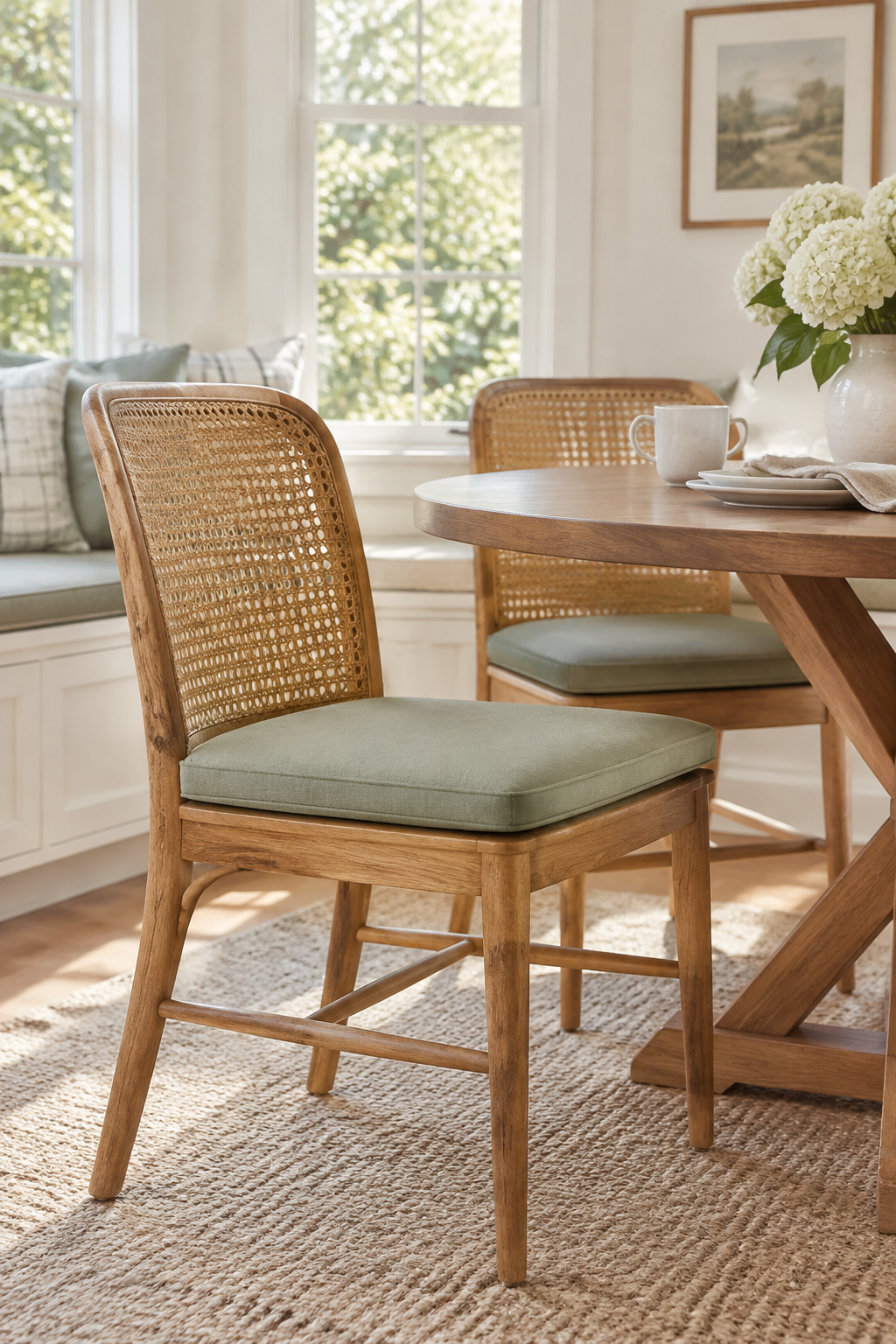
Fourteen floors up, the Cane Crossing balcony cushions lasted exactly one storm season before two of them ended up in the neighbor’s planter boxes and the rest spent every windy week huddled against the sliding door like refugees. Nobody on the ground floor has this problem. Wind, at height, is a different substance than the breeze the brochure photographed — and a balcony set that survives it is chosen by weight, shape, and anchoring logic, not by luck.
This page is the windward-owner’s guide: reading your exposure honestly, choosing a build that stays put, and accepting the one or two habits that high-floor life demands anyway.
Twenty floors of physics you did not order
Two effects make upper-floor wind worse than the weather report suggests. The first is speed: with nothing at altitude to slow it, wind strengthens with height, and a balcony railing — glass or slats — barely dents it. The second is the canyon: surrounding towers squeeze and redirect the flow, so a gust can round a corner and hit your balcony broadside from a direction the compass never promised. Together they produce the signature experience of high-floor outdoor furniture: a sustained breeze downstairs, and a periodic shove upstairs that treats a cushion like a sail — because aerodynamically, that is what a loose cushion is.
The shove works two ways. Push from behind drives a light pad over the railing rail or into the wall; suction on the lee side — the same negative pressure that lifts roofs in storms — can pluck a cushion upward and outward even from a seated stack. Light, lofty, high-profile cushions are the most sail-like; low, dense, close-fitting ones barely register in the same wind.
Will it fly? An honest living-room test
Before trusting any cushion to a windward balcony, run the poor man’s wind tunnel: hold the old pad flat at chest height outdoors on a breezy day and tilt it slowly. Feel how eagerly the airflow grabs it, how much the face presents like a wing. Now imagine that force arriving from an unseen quarter at two in the morning. The test is crude but it calibrates instinct — and instinct calibrated this way stops asking “will it blow away?” and starts asking the better question: how heavy, how low, how retained is the replacement?
Weight is a strategy, not a side effect
Here the cushion physics runs pleasantly against patio convention. The build levers that add service life also add mass: density up toward the top of the 35D to 65D range makes foam firmer and heavier; a fuller, squarer profile carries more of that dense fill; and pieces cut close to the frame’s true dimensions sit snug in the seat pan instead of perching on it. A snug 65D seat pad can weigh half again what the fluffy old one did — which in a sheltered garden means nothing and on a fourteenth-floor balcony means everything. The firmness is the honest trade: wind-resilient is a solid sit, and the reward is a set you stop thinking about at every forecast.
None of the ballast costs extra, incidentally. Every cushion starts from a $45 make-base and climbs only with finished size and chosen density — all 119 cloths in the swatch menu price flat at a given size, so the windward build is a specification decision, not a budget one. Cloth still deserves one windward-specific thought: tight, smooth weaves rattle less in flutter and shed the wind-driven grit that accompanies serious gusts, and every cover unzips fully for the balcony-laundromat version of machine washing that high-floor life imposes.

What wind grinds away, slowly
The dramatic failure is flight; the patient one is flutter. A cushion that stays put through a windy season still lives through thousands of hours of micro-vibration — fabric trembling against frame, seams flexing at a frequency nobody notices until the stitching wears. Add the grit that serious wind carries as cargo, dusting every surface with fine abrasive between rains, and a windward set ages by a slow sanding that sheltered yards never see. The counters are unglamorous: snug fit that lets nothing flutter, smooth weaves with no loose pile to whip, and a seasonal seam-check — thirty seconds running a thumb along every seam edge, looking for the fuzzy, abraded thread that says repair now rather than replace next year.
Staying put without gimmicks
On retention, honesty beats hardware. This bench does not sew straps, loops, or ties into a build — no sewn-in retention of any kind — and on a balcony that is less a limitation than it sounds, because the strategies that actually work are larger than stitching. Fit the seat pan snugly, so the frame itself is the restraint. Choose mass, as above. Site the furniture with the balcony’s aerodynamics in mind: the leeward corner behind the solid side panel shelters a chair better than the glass-front center ever will. And keep the one habit every seasoned high-floor owner has: on forecast storm days, the stack comes in behind the door. Weight buys you the ordinary Tuesday; no build buys you the named hurricane.
Frequently asked questions
One planning habit completes the windward toolkit: the storm drill, rehearsed once in calm weather so it runs itself in foul. Decide now — not at 11 p.m. under a severe-weather alert — which pieces come indoors, in what order, and where they stack; which stay out because they have earned their weight class; and what the balcony looks like fully buttoned versus merely abandoned. Owners with a drill lose furniture to wind roughly never. Owners without one discover, mid-gust, that the door was left unlocked, the stack has no plan, and the planter boxes two floors down have opinions about whose cushions those are.
How high up before wind becomes a cushion problem?
Roughly the sixth floor is where exposure starts outrunning garden-variety patio assumptions, and anything facing a corridor between towers deserves the windward treatment from any height. The self-test is simpler than the arithmetic: if your balcony furniture has ever migrated in a storm — or your neighbors’ has — you live in the zone.
Is a heavier cushion really enough to stay put?
For the ordinary gusty week, a snug high-density build sited out of the direct flow stays put convincingly — it is the fluffy light perch pads that sail. For forecast storms, nothing stays out responsibly, and the stack comes indoors. Weight extends what you can leave out, it does not abolish weather.
Why not add straps or loops to tie the cushions down?
Because this bench does not sew retention hardware into builds — no straps, no ties, no loops — and because on a balcony the load-bearing solution is fit, weight, and placement rather than stitching. A tied-down light cushion still flutters itself to death inside its restraints; a snug heavy one never asks the question.
Does glass railing make a balcony sheltered?
It redirects flow rather than removing it: wind arriving at an angle spills over and around glass — and curls downward on the lee side, exactly where a low chair sits. Solid side panels shelter better than glass fronts. Watch where leaves accumulate after a windy day and you have mapped your balcony’s quiet corner without software.
What density should a windward rebuild use?
Toward the top of the menu’s range — 65D seats if the sit suits you, otherwise as close as comfort allows within 35D to 65D, with backs correspondingly firmer. The density buys mass, lower flutter, and slower fatigue in the same decision. Frame fit matters as much: a pad cut snug to the seat pan cannot pivot into a sail.
Storm season starts in six weeks — can a set land in time?
Possibly, and only because you asked early. Sewing runs 4 to 7 business days standard, 3 to 5 rushed, but freight adds 3 to 6 weeks to most addresses — the math that decides the season is the trucking, not the cutting. Order now, and every piece lands within ±½″ of your figures, ±¾″ past 36″, remade free if not.
What ordering from this bench gets you
One workshop, in-house start to finish — the same hands cut, fill, and sew every piece, and have for over ten years. Figures re-checked against piece count before any cloth is cut — a suspicious measurement triggers a question, not a guess. No minimum order and no stock cycle — one refugee seat or the whole Cane Crossing set, in any of 119 fabrics. Fair-build guarantee: anything outside the ±½″ tolerance (±¾″ past 36″), built to the wrong cloth or the wrong spec, gets remade at no charge.
Cane Crossing replacement cushions for the balcony that gets the wind the ground floor never hears about — heavier, snugger, and boring about storms on purpose.
Balcony geometry unusual, or two exposures fighting each other? Describe the corner and the prevailing wind and we will place the pieces with you. For how rotation pairs halve wear on hard-served sets, the two-set strategy page runs the numbers — and the windward rebuild itself begins in the customizer with your seat-pan figures, flanked by the full Hampton Bay catalog for your other frames.