
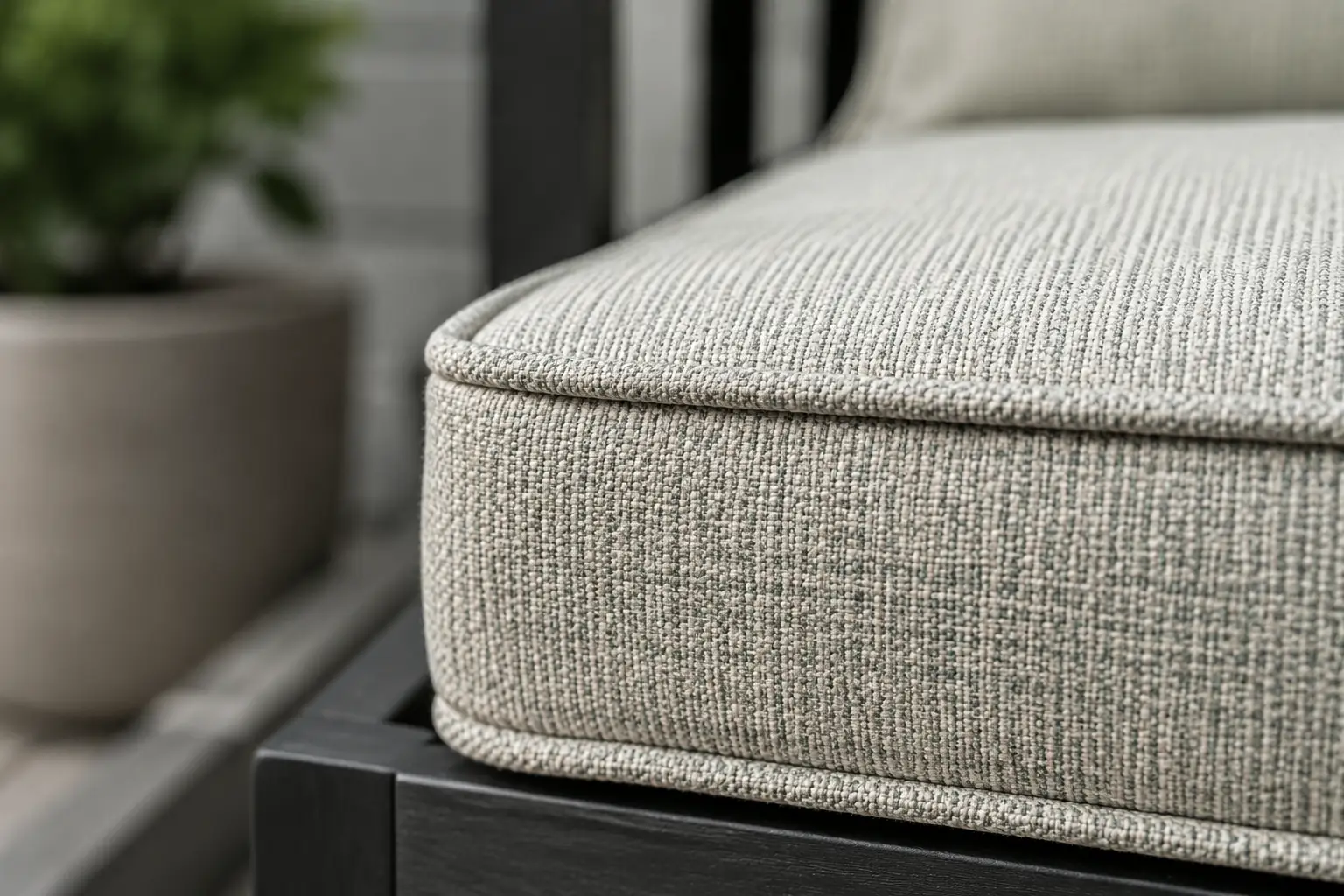
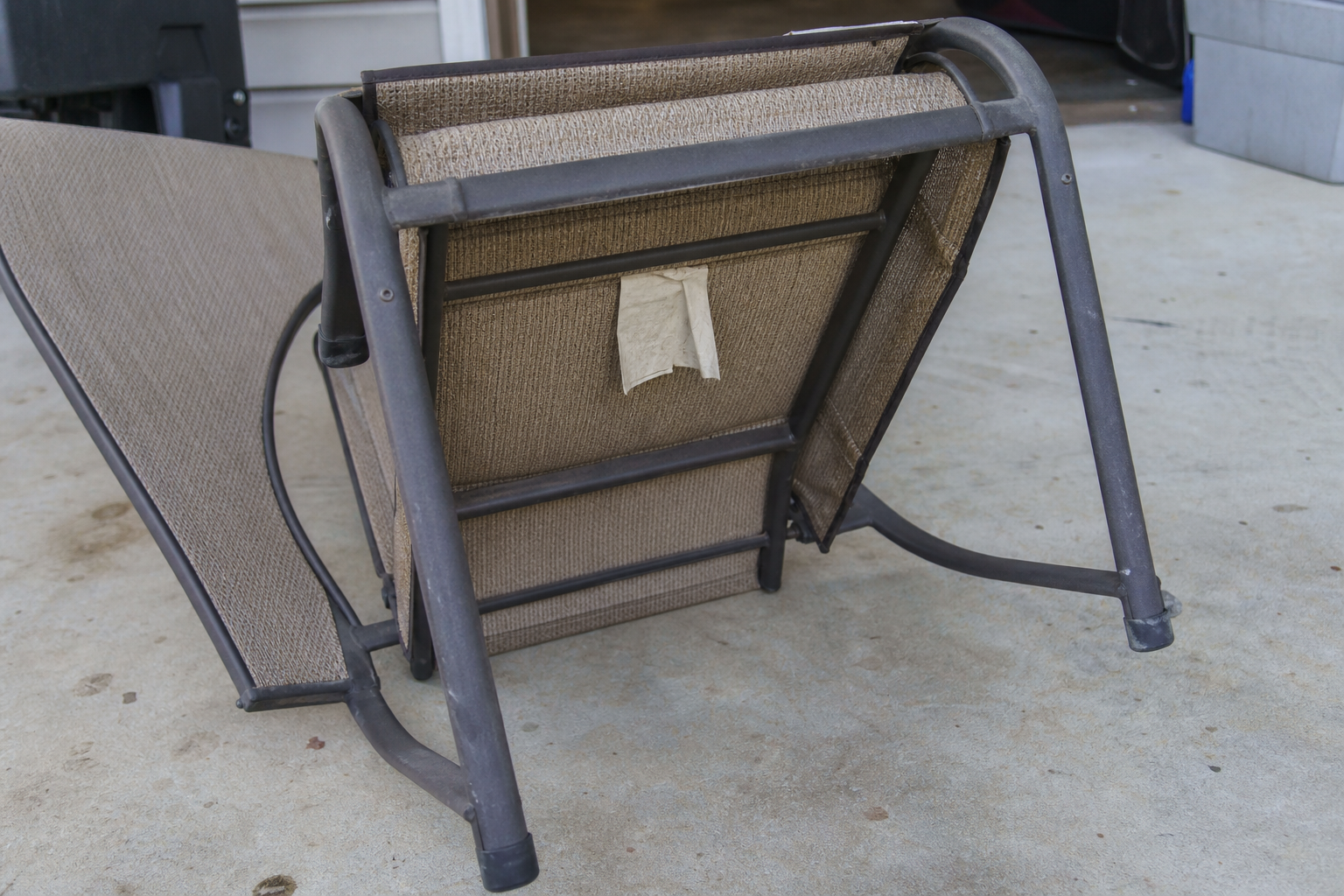
A Barnsley pad fails the way a car does — by parts, not all at once. The cover fades first but holds for years; the foam underneath quits quietly midway through the cover’s life. Knowing which part has failed tells you whether the right order is a full cushion rebuild or a fresh cover on cores worth keeping.
The two clocks inside every cushion
Textile and foam age at genuinely different rates. A decent outdoor cover fabric runs two lives of the foam beneath it: colors soften in year two or three, but the cloth itself — seams, zipper, weave — frequently holds structurally into year eight or ten. Foam keeps a different calendar. Three to five years of honest support, then a visible flattening as compression fatigue and airborne moisture dismantle the cell structure from inside. On a set that’s four years old with sun-faded but intact covers, the foam has almost certainly gone first.
The reverse failure happens too, just less often: a single catastrophic cover tear — a branch in a storm, a mover’s boot, one determined animal — over cores that still pass the palm test. Press the seat flat and count: recovery in under two seconds means the core still has its spine. That’s a cover problem, and cover problems have their own economical answer (below).
What the two-clock view buys you is spending discipline. Most owners replace whole cushions when only one clock has expired, or nurse dead foam under pretty covers for two extra seasons because the fabric “still looks fine.” Both moves cost comfort; one of them costs money too.
Reading your own set honestly
The full-rebuild route is what this workshop builds: complete cushions — fresh foam at your chosen density, fresh zip-off cover in any of 119 fabrics — cut to your measured figures rather than to a nominal size, since Barnsley never had a published chart. Where the diagnosis says “cover only,” our separate custom cover line sews to the same measured figures without touching serviceable cores.
Between rebuilds, the calendar is the cheapest maintenance tool there is. At season’s end, wash every cover, dry it fully, and store pads flat in a breathable container — a lidded deck box cracked open, a shelf in the garage, never a sealed plastic bin where trapped humidity spends five quiet months undo a year of care. Mid-season, a hose rinse and an afternoon of shade-drying resets whatever pollen, sunscreen, and general summer have deposited. And once a year, run the palm test across every seat in the set: it takes ninety seconds and it converts “should we replace these next year?” from a feeling into a measurement. Sets that get this modest rhythm routinely outlast their neighbors’ by whole rebuild cycles — the furniture equivalent of oil changes.
Sizing the rebuild or the cover identically
Both routes run on the same three figures per pad: clear width between the arms, depth along the flat seat deck, thickness at the seam — with back cushions recorded as width × height × thickness. Measure the furniture, not the intentions: a collapsed original reads thinner than the pad you want by half an inch or more, so where the old pad has visibly compressed, work from the deck and the measurement guides‘ corrected method.
Submitted figures get re-verified against your piece count before anything is cut, and the finished work carries the standard tolerance band — ±½″ per dimension, ±¾″ beyond 36″ — with free remakes whenever the build lands outside it on our side.
Naming the set, briefly
The series identification runs on the usual ladder and takes minutes when any rung survives: the white tag under the seat frame or inside an arm (model numbers usually sit behind a GLD or THD supplier code, and macro photos revive half-faded ones), your Home Depot account search for “Barnsley,” the original assembly manual. Open web searches mislead — Barnsley is a Yorkshire market town, and the internet will happily discuss it at length without ever mentioning patio furniture.
One caution with model years: Hampton Bay carried series names across seasons with quiet changes to arm profiles and cushion heights, so a Barnsley bought in 2016 and its 2019 namesake can legitimately need different figures. Measured orders absorb that automatically. When the tag and the paperwork are both gone, frame photos usually settle the series the same day — free, and before any order.
Prices and clocks you set yourself
Each cushion quotes from a $45 make-base and climbs only with size and foam density — 35D at the plush end through 65D for firm daily duty, priced live in the configurator. Fabric never moves the number: all 119 options carry one flat price over any density. A full-set order batches into a single confirmed quote; single pads carry no minimum.
Timing for either route: 4–7 business days of standard production, 3–5 rushed, and 3–6 weeks of shipping to most US addresses. Diagnosed in autumn, ordered in winter, seated by the first warm weekend — that’s the comfortable version of this cycle.
Neighboring uncharted lines like Salem and Charleston follow the same diagnosis-then-order path. Kampar keeps its chart-backed page; everything else sits in the Hampton Bay index.
Frequently asked questions
The covers look fine but everyone’s sinking — do I really need full cushions?
If the palm test runs slow — three seconds or more to rebound, a visible shadow after sitting — the cores are done, and no cover fixes that. A full rebuild at 55D or firmer resets the comfort clock for another long run.
Where does the diagnosis habit come from? Not from expertise — from the palm test and an honest look at the calendar, both of which take under a minute per chair. Households that run the test each fall effectively schedule their cushion spending years ahead: the set announces its needs a season early, the order goes in during the off-season lull, and the rebuild arrives before the first warm-weather complaint instead of after it.
Can I buy just covers for pads that are still firm?
Yes — that’s what the separate custom cover line exists for: sewn to your measured figures with the same zip-off washing standard, over cores that still rebound honestly. It’s the right spend when the cover clock expires first.
Is there a Barnsley size chart I can order from?
No — the series shipped without published pad specs, like most of this index. Orders run on your own figures: width, depth, thickness per pad, verified against your piece count before cutting.
How do the two routes compare on cost?
Covers-alone runs lighter than full cushions where it applies; the trap is applying it where it doesn’t — new fabric over dead foam is money spent on the wrong part. Diagnose first, then let the symptom table above route the order.
What density for seating used every single day?
55D–65D holds shape under constant load for years; 45D–50D suits weekend duty with a plusher hand. Density prices transparently per cushion from the $45 make-base, so the durability decision is never hidden in the total.
How far ahead should I plan?
Count 4–7 business days of production, 3–5 on rush, plus 3–6 weeks of shipping to most US doors — order in the off-season and the timeline becomes a non-event.
The workshop behind both routes
- Custom cushion manufacturing, ten-plus years, every order quoted, cut, and sewn in one facility.
- Figures re-verified against piece counts before cutting — a wrong number becomes a question, not a delivery.
- No stock, no minimums, all 119 fabrics flat-priced across the catalog.
- Tolerance guarantee of ±½″ (±¾″ beyond 36″), with free remakes for wrong fabric, wrong build, or off-spec cuts.
Barnsley replacement cushions — full rebuilds or measured covers, matched to whichever clock ran out — each piece from a $45 make-base.
Not sure which part failed or which series you own? Send photos — diagnosis is free. Or start from any custom shape / the series index.
Shipping & Delivery
- Orders over $158 ship free — add a second cushion or an upgrade and shipping’s on us.
- Smaller orders ship anywhere in the contiguous US for one simple flat fee — always shown before you pay.
- Made in 7–14 business days. Each cushion is cut and sewn to your measurements after you order, never pulled from a shelf.
- ±½″ tolerance on all custom cuts — and if we cut it wrong, we remake it free. No forms, no fine print.
Have a deadline? Contact us before ordering and we will tell you honestly whether we can meet it.
Related products
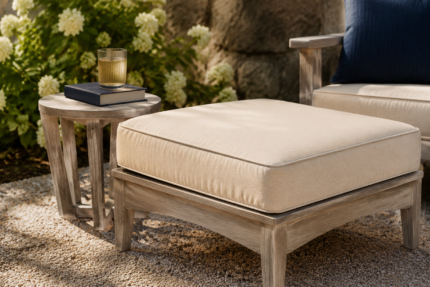
Custom Ottoman Cushions
- Ottoman cushions cut to your measurements — round, oval, square, half-round and wedge tops, no minimum.
- 119 fabrics at one price — covered-porch linens to solution-dyed acrylic with a 5-year fade warranty.
- Rounds price on the bounding square — the published formula the customizer quotes, checkable with a tape measure.
- Cut to a ±½" tolerance — outside it, remade free, any time. From $89.
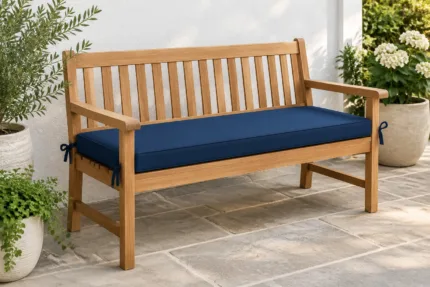
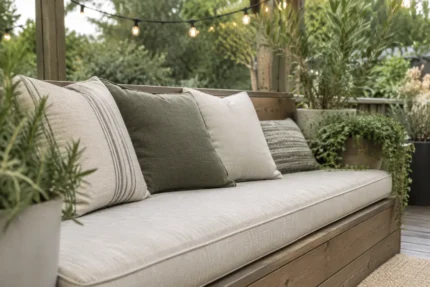
Custom Outdoor Bench Cushions
- Cut to your exact measurements — patio, garden and deck benches.
- 119 performance fabrics at one price — full-sun and quick-dry outdoor lines included.
- One order, one dye lot — every piece in the run ships color-matched.
- Factory-direct from $130 — instant quote in the customizer below.
- ±½″ tolerance, re-checked before cutting — remade free if we cut it wrong.
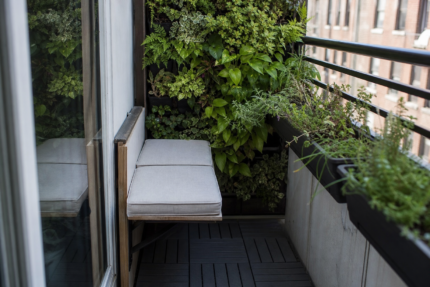
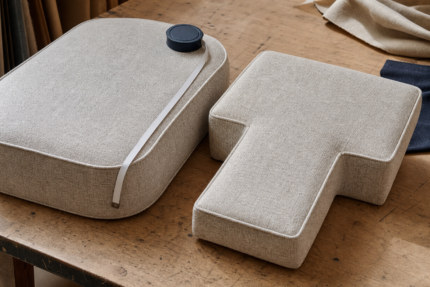
Custom Patio Cushions
- Cut to your exact measurements — dining chairs, deep seating, benches, chaises and swings, any shape.
- 119 performance fabrics at one price — full-sun and quick-dry outdoor lines included.
- One order, one dye lot — the whole patio set ships color-matched.
- Factory-direct from $88 — instant quote in the customizer below.
- ±½″ tolerance, re-checked before cutting — remade free if we cut it wrong.
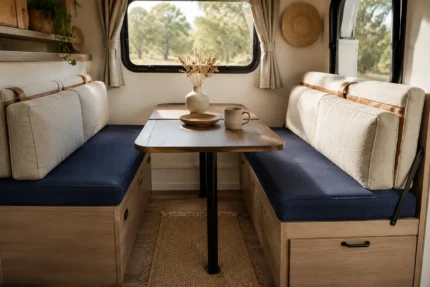
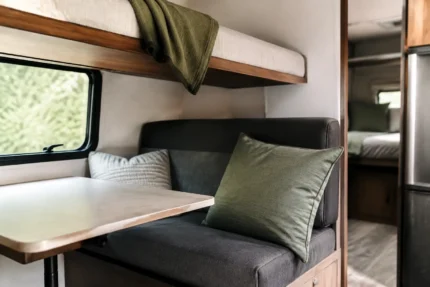
Custom RV Camper Cushions
- Cut to your exact measurements — dinettes, jackknife sofas, berths, any floorplan.
- 119 performance fabrics at one price — full-sun and quick-dry outdoor lines included.
- One order, one dye lot — every piece in the run ships color-matched.
- Factory-direct from $176 — instant quote in the customizer below.
- ±½″ tolerance, re-checked before cutting — remade free if we cut it wrong.