
Sydney (Hampton Bay)
The Sydney chairs down at the dock live closer to the water than any backyard set ever will, and the water keeps score. Orange-brown ghosts bloom on the seat covers no matter how often they are washed. The seams along the front edges thin out years before the rest of the cloth. And the metal — armrests, frames, the cleat the lounge chair leans against — slowly prints its own chemistry onto everything it touches.
None of this is the fabric failing early. It is dock life attacking cushions by three specific mechanisms that a lawn-side set never meets, and each one has an answer.
Rust transfer is not a stain
The marks confuse everyone once. A stain sits on top of cloth and washes out; rust transfer is iron oxide migrating from wet metal into the fibers, chemically bonding where it lands. The sequence needs all three actors: moisture, bare or scratched metal, and contact time. A chair frame with a chipped foot rests against a damp cushion overnight, and by morning the cloth carries a shadow the exact shape of the touch point.
The defense is breaking the sequence, not fighting the mark afterward. Keep the metal honest first — touch up scratched frame paint at the start and middle of the season, because intact coating does not transfer. Then inspect the specific places cushions touch hardware: the spot where a seat back rests against a railing post, the arm pad sitting on a bitt or cleat, anything stored leaning against the dock box hinges. Those contact points are where ninety percent of transfer originates, and they are also where a thick enough cushion body keeps cloth from pressing directly into metal joints that hold grit and brine.
The abrasive budget of dock life
Salt spray dries into fine crystals, and crystals are an abrasive. Every time a body shifts on a seat, the cloth grinds against a thin layer of grit that a backyard set only meets after a dusty August. That is why dock cushion seams fail from the inside out: the stitching abrades against grit worked into the weave long before the visible surface looks tired.
Rinsing is therefore maintenance, not cleanliness. A fresh-water hose over both faces of the cushions every week or two dissolves the salt film before it accumulates — ten minutes for a whole set. Add a seam-line pass at the end of the season, running the rinse along each seam rather than across it, and the threads get the longest life available to them. Cloth choice leans the same direction: tight, smooth weaves release grit in the wash that loose textures hold onto.
Front-edge duty: the boarding step
Watch a dock for an hour and count how many people sit on the front edge of a seat to take shoes off, step into a boat, or haul a cooler past. The front edge of a dock cushion is a working surface, and it carries point loads the middle of the seat never sees — a concentrated body weight on two inches of foam, with the sharp frame edge directly beneath.
Two habits and one spec absorb this. Habit one: rotate the pieces if the set allows it, so one chair does not serve every boarding for a whole season. Habit two: teach the household to step from the middle of the seat, not the edge, when hands are full. The spec: dense foam in the 60D range under sitting weight, roughly 55D behind the back, holds a crisp front edge under exactly this abuse where a soft fill would crush into a permanent lip within a couple of seasons. The full menu runs 35D to 65D, so the choice is deliberate, not default.
The metal audit, twice a season
- Walk the set with a rag. Wipe every point where frame meets cushion. Orange residue on the rag names your transfer sources before the cloth names them for you.
- Check fasteners and welds by hand. A bolt working loose or a weld crack opening is both a safety item and the next rust origin. Tighten, seal, or flag it.
- Look under the seats. The hidden underside of a frame corrodes first in splash zones; what starts under there migrates upward into pads at every contact.
- Photograph the contact points in May and September. Two photos a year, compared side by side, show whether a mark is stable or advancing — the difference between a touch-up and a re-coat.
Twice a season sounds like ceremony until the first year it catches a railing tie-down three weeks before it would have printed itself onto six seat backs.
What dockside cushions cost
Dock duty does not move the pricing logic an inch. Every Sydney piece starts from the same $45 make-base and climbs only with finished size and density across the 35D to 65D range; all 119 cloths in the swatch menu price flat at a given size, so choosing the salt-smart tight weave over a delicate texture never costs a dollar more. Sewing runs 4 to 7 business days standard, 3 to 5 when the season is already at the water without its seats, and freight adds 3 to 6 weeks — which is why winter is the dock house’s quiet season for exactly this kind of order.
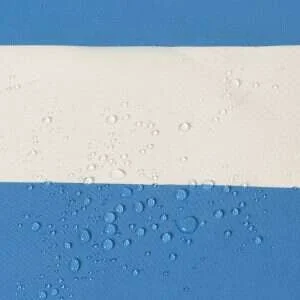
Every cover zips off completely for machine washing — there is no sewn-shut panel on any build from this bench — and at a dock, where a wash cycle is a monthly event rather than a season-end one, that is the specification doing real work.
Frequently asked questions
Why do brown-orange marks appear when the fabric itself never rusted?
Because the iron came from somewhere else. Rust transfer migrates off wet or scratched metal — frames, railings, hardware — and bonds into the fibers on contact. Washing fades it slowly at best; the durable fix is upstream, on intact metal coatings and managed contact points, before cloth and hardware ever touch.
My chairs sit on a floating dock. Does that change the rules?
It adds one: constant low motion. A floating platform never stops shifting, so cushions and frames rub against each other in a slow permanent rhythm, and that rubbing works grit into the weave faster than static sitting does. The weekly rinse matters more on floats, and smooth tight weaves earn their keep — they give grit nowhere to settle and grind.
Which colors buy the most time between washes at a dock?
Mid-tone and patterned cloths hide transfer shadows and salt lines longest; pale solids announce them. All 119 fabrics price identically at a given size from the $45 make-base, so choosing the forgiving color over the demanding one is free — and at a dock, forgiving is usually the color that matches the decking.
How wet is too wet to sit on?
A damp cushion is a comfort question, not a damage one: blot, air, and carry on. The structural rule is simpler — never store cushions pressed together while soaked, and never leave them face-down on a wet deck overnight, which traps moisture against the cover for hours. Upright, spaced, and airflow-adjacent is how a dock set dries without souvenir marks.
Does cushion thickness insulate against hot metal frames?
Markedly. A dock frame in afternoon sun holds heat long past the point where bare metal is comfortable, and a substantial foam body between skin and rail is most of the solution — the thicker the pad across arm and contact zones, the less conductive heat reaches the surface. It is one of the quiet arguments for full-thickness rebuilds over thin refresh pads on waterfront frames.
What density belongs on seats that double as a boarding step?
When front edges take point loads from shoes, coolers, and boat boarding all summer, 60D under sitting weight holds its shape where soft fills crush into a permanent lip. The menu spans 35D to 65D, and dock sets are the clearest case for the upper half of it — with about 55D behind the back, where loads are lighter.
What ordering from this bench gets you
One workshop, in-house start to finish — the same hands cut, fill, and sew every piece of a dock order, and have for over ten years. Figures re-checked against piece count before any cloth is cut — a doubtful measurement triggers a question, not a guess. No minimum order and no stock cycle — two dock chairs or the whole marina-side set, in any of 119 fabrics. Fair-build guarantee: anything outside the ±½″ tolerance (±¾″ past 36″), built to the wrong cloth or the wrong spec, gets remade at no charge.
Sydney replacement cushions rebuilt for the waterline — dense where the boarding happens, washable where the salt lands, honest about the metal.
Unsure which contact points to photograph first? Send pictures of the frames and hardware and we will flag the risk spots. If your dock chairs winter in a boat shed or garage, read how a waterfront storage season is handled — then place the order through the made-to-your-numbers form. The full Hampton Bay catalog shows the Sydney line in context.