
Salem (Hampton Bay)
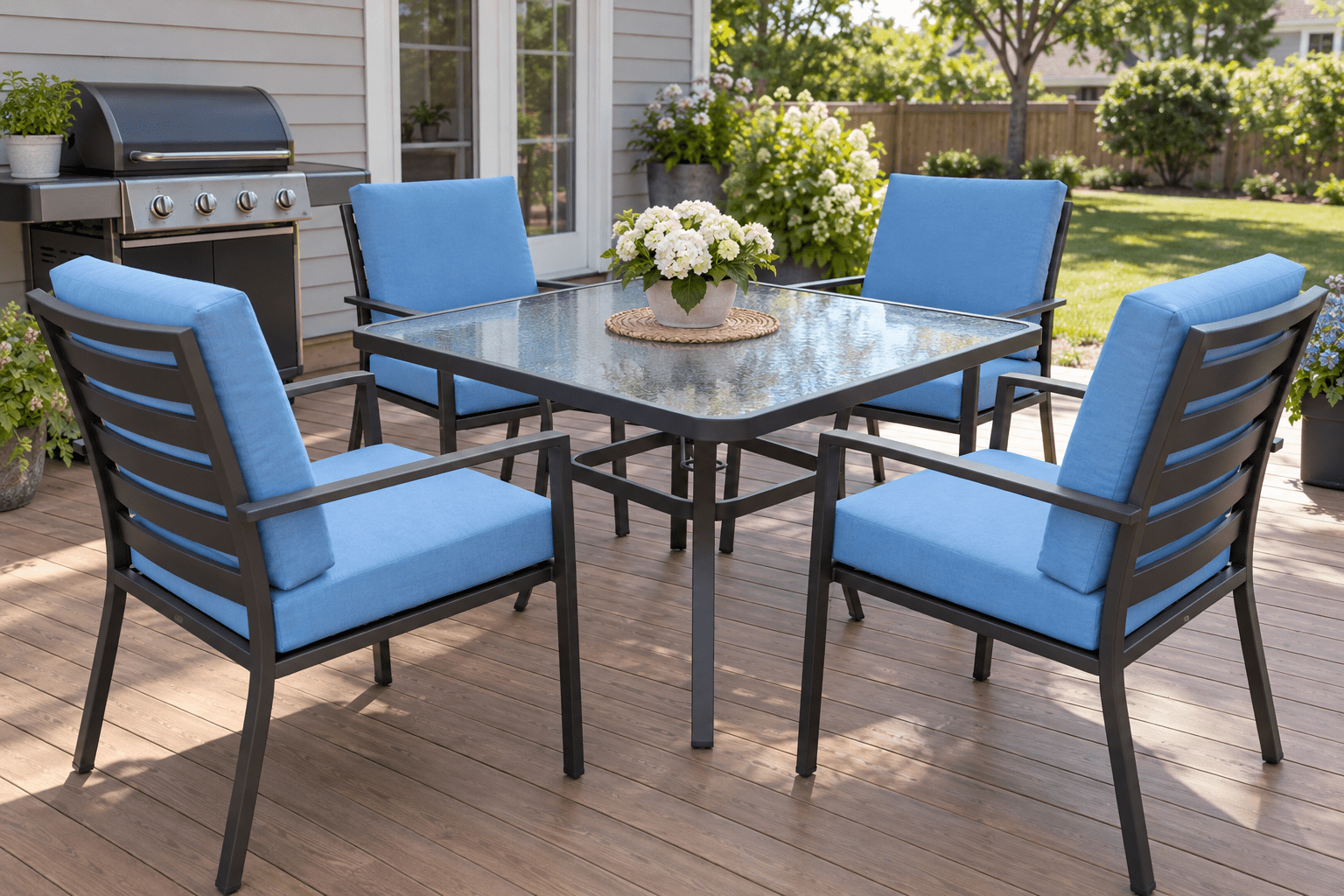
The Salem pieces in most yards are not one set — they are three sets pretending to be one. Two chairs flank the front door, a dining group works the back patio, and a bench sits in the side passage where nobody lingers. Bought in a single afternoon, usually to a single spec, and two seasons later the mismatch shows: the front pair still looks new because nobody sits there, the dining seats are tired, and the passage bench has been dragged against the fence so many times its covers look sandblasted.
The fix is not better cushions everywhere. It is different cushions per zone — sized, filled, and covered for the job each corner of the yard actually does.
Three zones, three different jobs
Walk your property once with a clipboard and the zones draw themselves. The front stage is whatever a visitor sees in the first ten seconds: porch chairs, an entry bench, the pair under the window. It is photographed more than it is sat on. The living patio is where hours actually pass — the Salem dining chairs that carry breakfast, homework, and long dinners, the seats that get moved toward the fire bowl and back. The passage is furniture that works for a living: the side-yard bench that collects packages, the stool by the gate, anything whose main job is being grabbed, shifted, and set back down.
Each zone destroys cushions by a different mechanism, so each zone earns a different build. Dressing all three to the same spec means paying for durability where nobody sits and getting fragility where everybody does.
The front stage: dressed for the photograph
Low traffic changes the arithmetic completely. A chair that hosts guests four evenings a month does not need the densest foam in the range — it needs to look expensive for years on minimal service. That points to loft over firmness: something in the mid band, around 55D, holds a crisp silhouette and full edges through seasons of light use, and the money you did not spend on density goes into the cloth instead.
This is the zone where texture earns its price. A ribbed weave, a heavy boucle feel, deep saturated color — choices that would look risky on a chair someone eats spaghetti in — read as deliberate and groomed at the front door. All 119 cloths in the swatch menu carry the same figure at a given size from the $45 make-base, so upgrading the look costs nothing but the decision.
The living patio: bought for the body
The workhorse zone inverts every one of those priorities. Here the foam does real work daily, so the honest spec is around 60D under sitting weight and about 50D behind the back — inside the 35D to 65D window the menu allows, at the end that keeps daily-use seats from smoothing down to pancake by the second summer. Here too the fabric should be chosen for how it forgives: tight, plain, close-woven cloths shed a dropped drink when it is blotted promptly, and every cover unzips fully for machine washing when blotting is not enough — there is no sewn-shut panel on any build from this bench.
One rule keeps the zone honest: measure the Salem frames as they are today, not as the old tag claims. Wobblier frames have shifted a quarter inch here and there over the years, and your own three figures per cushion outrank any series chart.
The passage: built to be moved
Passage furniture fails by abrasion and by handling, not by sitting load. The bench that gets shoved along concrete to mow underneath needs covers that tolerate scraping; the package bench needs a cloth that hides soil and washes without ceremony. Weight matters more than owners expect — a lighter, slightly thinner pad gets moved properly instead of dragged, and dragging is what actually chews the seams. A modest fill in the 45D neighborhood keeps the bench comfortable for the two minutes people actually sit on it while lifting nothing heavier than its own job.
None of this is compromise. It is matching the punishment to the purchase, and it is why the passage zone is often the cheapest order of the three.
Measuring a zoned order without a mix-up
Three zones measured in one afternoon is how sets get scrambled — a front-chair figure written on the same sheet as a dining seat, and now nobody knows which number is which. Zone the paperwork before touching a tape:
- Prefix every piece. F for front, L for living, P for passage, then a number: F1, F2, L1 through L6, P1. The prefix travels with the cushion through ordering, delivery, and installation.
- One sheet per zone, bagged separately. Width, depth, and thickness at the seam for every piece, per the measuring guides — and the tape measure never crosses zones mid-sheet.
- Photograph each zone with its sheet in frame. Six weeks later when cartons arrive, the photo answers every “which seat was 19 × 18?” question in two seconds.
- Order by zone if budgets run tight. Zones are natural batches — the living patio ships first and gets used while the front stage order follows.
One Salem-specific caution belongs here. No trustworthy cushion chart was ever published for this line, and the name carries a retailing trap: “Salem” also circulates on outdoor furniture sold at Lowe’s, built with no connection to Home Depot’s Hampton Bay. The white manufacturer tag under a seat frame — model number beside its GLD or THD prefix — settles which Salem you actually own. Trust your tag and your tape over any chart, including ours.
What three zones cost
Zoning does not carry a pricing penalty — the opposite, usually. Every cushion in every zone starts from the same $45 make-base and climbs only with finished size and chosen density from 35D to 65D; cloth never moves the number, because all 119 options in the swatch menu price flat at a given size. A front-stage chair in a lush weave, a living-patio seat in workhorse canvas, and a passage bench pad in soil-hiding tweed all bill by the same arithmetic. Splitting the order by zone lets each batch ship when it is ready rather than holding the whole yard hostage to the slowest piece.

Sewing runs 4 to 7 business days as standard, 3 to 5 when a zone genuinely cannot wait, and freight adds 3 to 6 weeks to most addresses — which is exactly why zoning the order matters: the living patio lands first and starts earning while the front stage is still in production.
Frequently asked questions
Do all three zones have to be ordered together?
No — zones make natural separate orders, and splitting them is often smarter. The living patio is the time-sensitive batch; the front stage and passage can follow a pay-cycle later without anyone suffering. Each batch runs its own 4-to-7-day sewing window with freight on top of 3 to 6 weeks.
My Salem furniture came from Lowe’s. Is that the same line?
Almost certainly not. “Salem” circulates as an outdoor-furniture name outside the Hampton Bay channel, and the builds are unrelated. The manufacturer tag under the frame — and its GLD or THD prefix — is the deciding evidence. Either way, this bench cuts to your measurements rather than a chart, so the numbers win over the name.
Can I spec the front zone like the living zone and be done with it?
You can over-build the front — 60D seats on rarely-sat chairs simply cost a little more density than needed. The reverse is the mistake: dressing a daily dining chair to front-stage specs is how sets look aged by August. Over-build is safe; under-build is the one-way error.
Should the three zones match in fabric?
Only if the sightlines connect — a porch visible from the dining patio rewards some echo between the two. Otherwise the zones are separate rooms outdoors, and different cloths read as intentional layering. With all 119 fabrics flat-priced from the $45 make-base, variety costs nothing.
What thickness works for the passage bench?
Thinner beats thicker for furniture that gets moved: a modest profile keeps the bench light enough to lift properly instead of dragged, and dragging is the real seam-killer in a passage zone. Comfort for short sits survives fine at a slimmer cut, with density around the 45D mark doing the supporting.
Does the ±½″ tolerance apply per zone or per order?
Per piece — every cushion in every zone is built to your figures within ±½″, widening to ±¾″ past 36″, and anything outside that gets remade at no charge. Zone prefixes just keep the right cushion landing on the right frame when the cartons multiply.
What ordering from this bench gets you
One workshop, in-house start to finish — the same hands cut, fill, and sew every zone of the order, and have for over ten years. Figures re-checked against piece count before any cloth is cut — a suspicious measurement triggers a question, not a guess. No minimum order and no stock cycle — one passage bench pad or a full three-zone rebuild, in any of 119 fabrics. Fair-build guarantee: anything outside the ±½″ tolerance (±¾″ past 36″), built to the wrong cloth or the wrong spec, gets remade at no charge.
Salem replacement cushions zoned properly — dressed at the door, working on the patio, light in the passage.
Not sure which zone a stubborn piece belongs to? Send photos of the frames and we will sort them with you. Want fabric ideas per zone? See how a full-sun cloth decision reads — or place the whole three-zone order with cushions made to your numbers. The full Hampton Bay catalog puts your Salem pieces in context.