
Park Meadows (Hampton Bay)
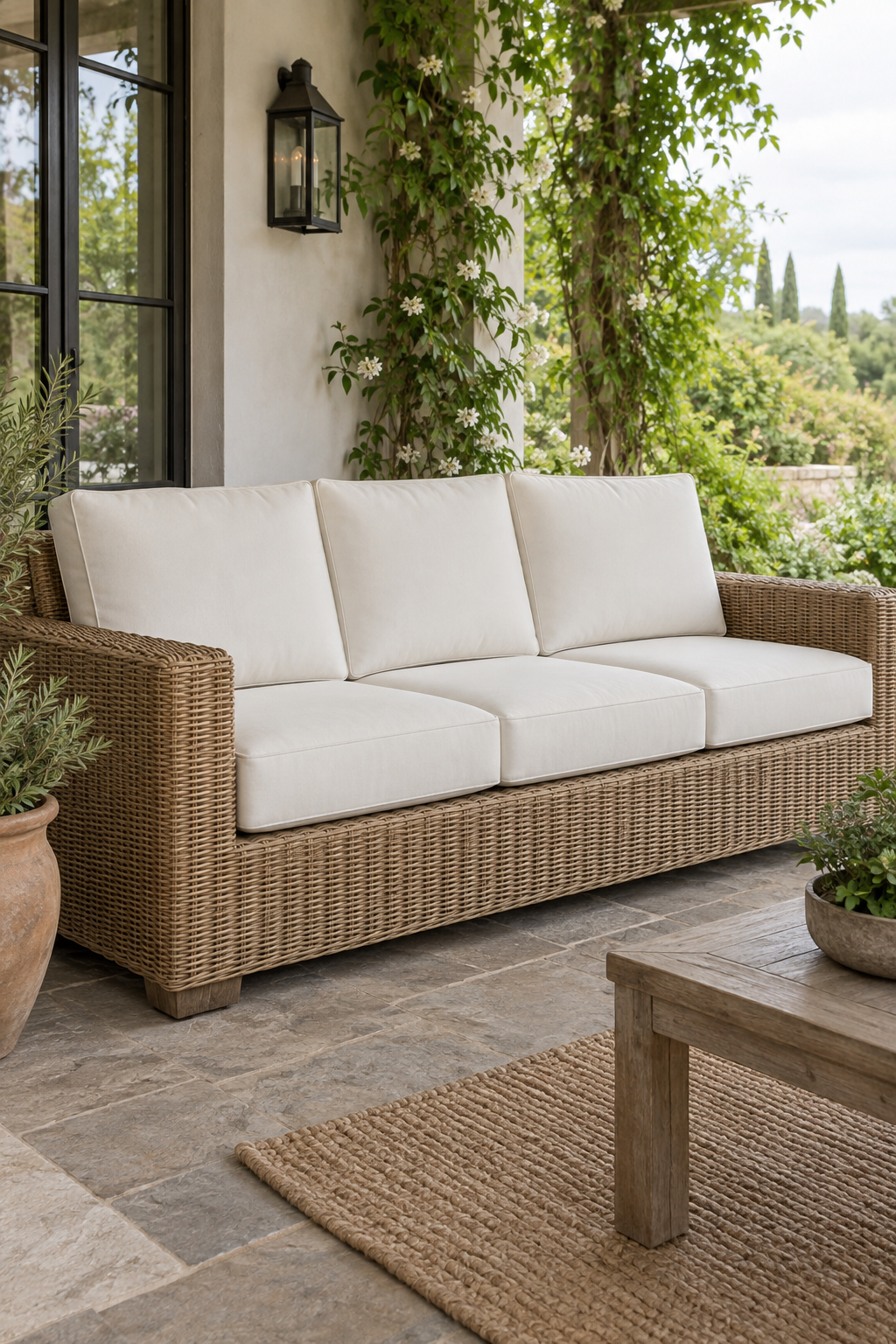
It was the shorts that settled the argument. A dark charcoal cover on the Park Meadows lounge chairs — handsome, sophisticated, exactly what the mood board wanted — and by two in the afternoon on the first warm Saturday, sitting down meant negotiating with a surface that had spent the morning becoming a griddle. Jeans survivable, bare legs not. The chairs were fine. The color was the problem, and nobody had factored it because nobody talks about cushion color as a thermal decision.
This page does: how dark and light actually behave in afternoon sun, what each costs the sitter, and how to zone color across a yard by the hours each corner gets used.
Dark, light, and the physics in between
The physics is honest and slightly unfashionable. Dark surfaces absorb most of the sunlight that lands on them, converting it to heat right there in the cloth — on a still summer afternoon a near-black cushion face can run hot enough to be genuinely untouchable, where a white one in the same sun stays merely warm. Light surfaces reflect that energy away instead, at a cost of their own: the glare off a bright-white cushion in low-angle evening light is real, and reflection does nothing for the heat your body adds by sitting. Mid-tones split the difference — absorbing less than charcoal, glaring less than white — which is why sand, sage, taupe, and muted blue families dominate sensible patios in hot climates. None of this is aesthetic theory; it is the reason the same chair is a throne at five p.m. and a liability at two.
What heat does to the sitter, not just the palette
The comfort cost of a hot cushion is not just the moment of landing. A seat that runs very warm changes the whole posture of use: sitters perch on edges, drape towels, drag the chair into the shade and wreck the arrangement, or simply abandon the sunny corner until dusk — all quiet votes against a color chosen in February. Skin contact with an over-hot face is also a genuine, if minor, hazard for children and for anyone who sits first and looks second. The test costs nothing: on the next warm afternoon, lay the back of your hand on each cushion you own and rank them. That ranking, cross-referenced with when each seat actually gets used, is the entire framework — everything below is application.
Zoning color by the sun clock
The mature move is refusing to pick one color for a whole yard. Zones of use, matched to zones of sun:
- The afternoon set — mid-tones or light. Whatever sits in open sun through the hot hours earns a light-to-mid cloth: sand, cream, weathered blue. These chairs get sat on at peak heat, and their fabric should be in the reflecting business then.
- The evening fire-corner — dark is welcome. The chairs that come alive after six, around the fire bowl or under the lights, never meet peak sun. Here charcoal and deep navy deliver their look without the griddle hours, and they hide the soot and spilled-red-wine realities of night use.
- The dappled and part-sun pieces — anything you love. Half-shade seats under pergolas and trees run cool enough that color is free to be purely a design choice. Spend your boldest cloth here.
Because all of this lives in one swatch menu, the zoning costs nothing but intention — and a yard zoned this way photographs better than a matched set ever did, because the variation reads as designed rather than accumulated.
That last clause is literal: every cushion starts from a $45 make-base and moves only with finished size and density chosen within 35D to 65D, and all 119 fabrics — charcoal to chalk-white and back — price identically at a given size. Color is the one major cushion decision that is thermally loaded and financially free. Density remains a separate conversation for the body: about 60D for seats in daily service, near 50D for backs, chosen inside the same range.
Heat, honesty, and the long game
Two quiet second-order effects deserve straight sentences. First, sustained surface heat mildly accelerates the same aging processes that sun drives anyway — a dark cushion in all-day sun lives a somewhat harder life than a light one beside it, so the evening-corner placement of dark cloths is longevity strategy as much as burn prevention. Second, light cloths make the opposite trade: cool to sit on, faster to show soil and sunscreen marks, and therefore more dependent on the wash routine — which is easy here, since every cover unzips fully for machine washing, with no sewn-shut panel on any build. Choose light for the hot zone accepting laundry; choose dark for the evening corner accepting nothing. The mid-tones, as usual, keep winning.
Frequently asked questions
A note on the chairs the sun never reaches, because every yard with trees or tall neighbors owns one: full-shade seating inverts the whole calculus, and dark cloth stops having any thermal price at all. The reading pair under the maple can wear the deepest espresso in the menu and never know the difference; the north-facing bench can carry charcoal through August without incident. The zoned approach is really three budgets of sun, and the shade zone’s budget is infinite — which is why thinking in zones beats thinking in a single “yard color” every time. Match the cloth to the exposure each seat actually lives in, and every seat in the yard becomes the right seat at the hour it is used.
What color stays coolest in afternoon sun?
White and the near-whites — cream, shell, bone — reflect the most and run the coolest, with the light sands and pale greys a half-step behind. The practical sweet spot for most yards is the light-to-mid band: nearly as cool, far more forgiving of ordinary life than true white.
Is white too glaring to actually enjoy?
In low evening light, a bank of bright-white cushions can genuinely dazzle — the reflection problem is the mirror image of the absorption one. If your patio faces west and evening is your main hour, drift to cream or pale sand instead; they keep most of the cool-seat advantage with a fraction of the glare.
Light covers show every mark — is the trade worth it in the hot zone?
For seats that are truly unpleasant when dark, yes — comfort outranks laundry. Mitigation is routine here: every cover unzips fully for machine washing, and weekly-in-summer keeps light cloth looking like itself. In the dappled and evening zones, keep to mid-tones and spend none of the effort.
Does a dark cushion actually damage the foam underneath?
Not damage, exactly — gently accelerate. A very hot black face in all-day sun pushes the cloth and foam through more thermal cycling than a light one beside it, and thermal cycling is one of the quiet inputs to aging. Sited in the evening corner, the dark cloth skips those hours entirely and the question dissolves.
Does color change the price at all?
Never at this bench. All 119 cloths price flat at a given size from the same $45 make-base — the ivory and the charcoal bill identically, and only finished size and density (35D to 65D) move a number. Thermal planning is the rare engineering upgrade that costs zero.
Can I see cloth in person before committing a full set?
Yes — and for a sun-zoning decision it is worth it, because hand-feel and glare never photograph honestly. Ask the bench for swatches, lay finalists on the actual chairs through one afternoon, and let the two o’clock test make the final call. Sewing runs 4 to 7 business days once decided, 3 to 5 rushed, freight 3 to 6 weeks beyond that.
What ordering from this bench gets you
One workshop, in-house start to finish — the same hands cut, fill, and sew every piece, and have for over ten years. Figures re-checked against piece count before any cloth is cut — a suspicious measurement triggers a question, not a guess. No minimum order and no stock cycle — one burned-leg lounge chair or the whole zoned yard, in any of 119 fabrics. Fair-build guarantee: anything outside the ±½″ tolerance (±¾″ past 36″), built to the wrong cloth or the wrong spec, gets remade at no charge.
Park Meadows replacement cushions picked the way hot-climate designers pick — by sun clock and sitting hour first, mood board second.
Yard orientation unusual, or unsure which corner counts as your hot zone? Describe the sun and your sitting hours and we will map it with you. For how weave and texture play against color, the covered-porch fabric page works the same menu from the shade side — and the zoned order itself comes together in the customizer, one color per zone, with the full Hampton Bay catalog for the rest of the set.