Braxton Park (Hampton Bay)
A pool asks a different question of fabric than a lawn does. Grass stains and spilled lemonade are household problems; a poolside delivers chlorinated water as airborne mist, wet bodies flopping down still dripping, and — the one nobody budgets for — sunscreen in industrial quantities, applied generously and reapplied hourly. A Braxton Park set near the water lives in that bath. The cushions nearest the ladder will tell you: pale streaks where chlorine aerosol settles, faint orange halos where lotion met sun-warmed polyester, and a crisp line across every seat back at exactly splash height.
Two chemicals, two stains
The damage poolside fabric takes comes from two directions, and they leave different signatures.
Chlorine bleaches from the top down, gently and everywhere. The mist that rises off turbulent water drifts onto whatever sits within its reach and does what dilute bleach does — not a dramatic white splotch, but a slow, even paling of the seat tops and the splash-line of the back-rests. Colored fabric simply loses saturation season over season. Nothing you do after the fact restores it; the defense is choosing cloth whose dye system survives the exposure in the first place.
Sunscreen stains in bullseyes, from the bottom up. Lotions are oils carrying actives, and oil loves polyester: a wet shoulder blade or the back of a calf presses a print into the seat, the sun cures it within the afternoon, and a yellow-orange shadow stays behind after the wash. The stains concentrate exactly where bodies contact fabric — the seat’s rear edge, the back-rest’s midline — and they compound, one application at a time, all summer.
Neither chemical is exotic. Both are why ordinary household outdoor fabric near a pool tends to look five years old by the second August — and why the fabric specification, not the color name, is the decision that matters at the water’s edge.
The dye system is the armor
Fabric performance against chlorine and sun comes down to how the color got into the fiber. In conventionally dyed weaves, color coats the outside of the yarn after weaving — which is exactly the layer chlorine aerosol and ultraviolet attack first. In solution-dyed cloth, the pigment goes into the fiber before spinning, distributed through the material itself: there is no surface coat to strip, so paling and fading lose their grip. The same structure shrugs at sunscreen’s oil fraction better, because the stain sits on a fiber it cannot soak into as deeply, and a warm wash lifts more of it.
Within the workshop’s 119-fabric menu, the practical poolside move is simple: ask for the solution-dyed outdoor family, and then pick your color knowing the chemistry. Mid-tones and multicolor weaves are forgiving — a residual lotion shadow disappears into a pattern’s own variation, and gentle chlorine drift reads as sun-worn rather than damaged. Crisp white looks pristine for one season and then keeps the score; saturated deep colors show paling soonest, so at the pool they earn their depth only under shade structures.
Texture deserves the last word of the specification: a tight, smooth weave gives oils less purchase than a nubby or plush one, and dries faster after the third cannonball of the afternoon. Save the velvets and the loose bouclés for the covered bar area; give the ladder-adjacent chairs the smooth technical cloth.
The rinse discipline
Fabric choice sets the ceiling; habits decide how close to it you get. Poolside maintenance is three moves, none of them strenuous. First, the hose pass: after a heavy swim day, a quick rinse of the seat tops with plain water dilutes the chlorine film before it dries into work. Second, the day-of wash: when a sunscreen print appears, unzip the cover and launder it that day — cured lotion is a stain, fresh lotion is a chore. Every cover this bench builds unzips fully off the foam for exactly this: machine washing as pure cloth, the foam never soaked. Third, the end-of-season full cycle: all covers through the wash before storage, so the summer’s chemistry does not overwinter pressed into the weave.
And one piece of free insurance that beats everything above: towels. A stack by the door, and a house rule that wet, lotioned bodies land on terrycloth first, moves the entire problem one layer out from your cushions. The best poolside fabric strategy is the one that rarely gets tested.
Naming the poolside set
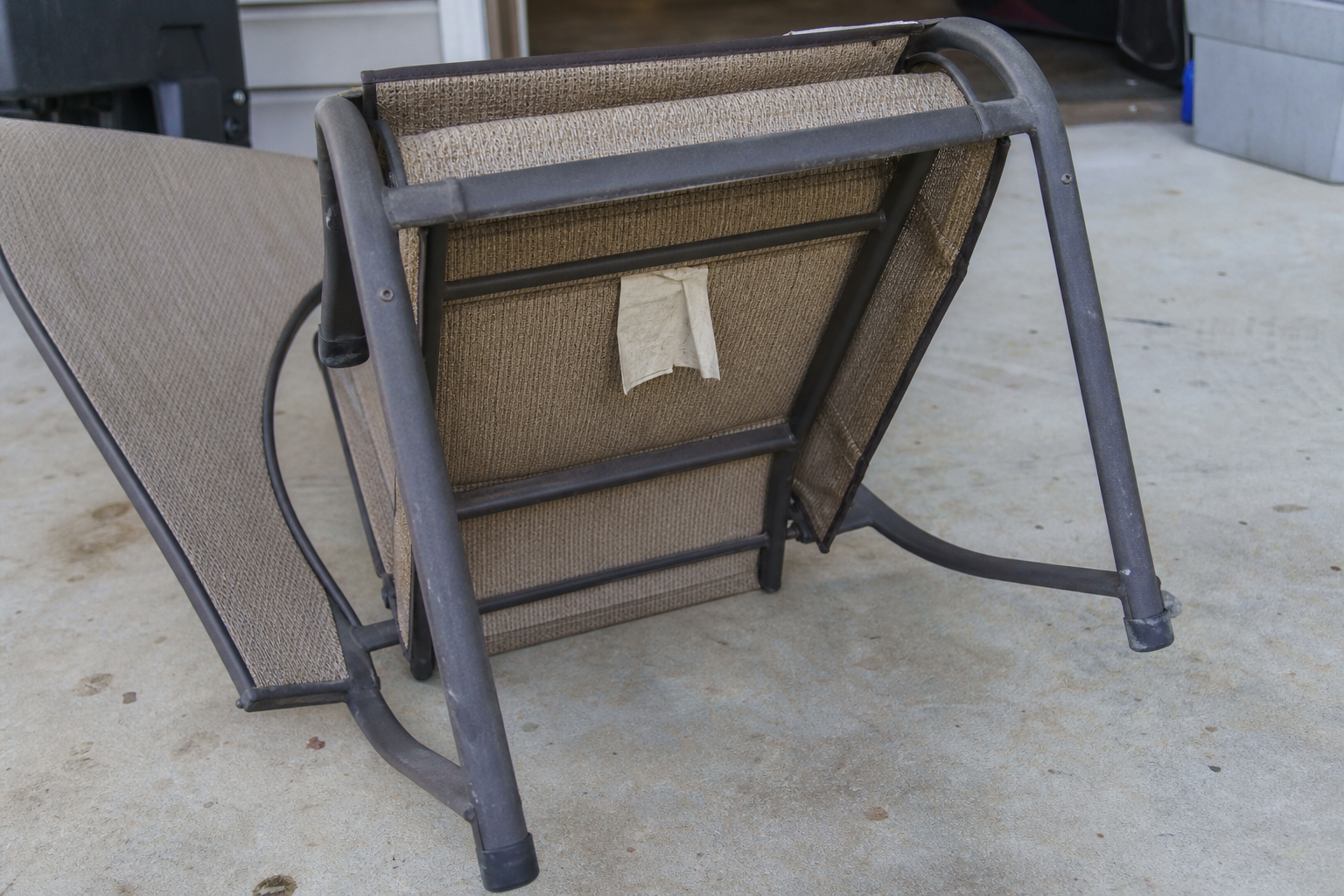
Braxton Park sits in the uncharted portion of the Hampton Bay catalog — tracked through retail listings and owner reports, with no official cushion chart published. Identification runs the standard route: flip a chair and read the white tag under the seat frame, where the model number rides beside a GLD or THD supplier prefix; check Home Depot order history or the original assembly leaflet; and if both have gone the way of last season’s goggles, photos of the frames sent to the bench narrow the construction era. However the name resolves, the cutting specification is your own three figures per cushion — width, depth, thickness at the seam, per the measuring guides — because same-name sets across model years have carried different lofts.
Waterline cloth at dry-land prices
The chemistry-resistant cloths are not a premium shelf here: every cushion begins at a $45 make-base and only finished size plus density — selected anywhere in 35D to 65D — move the number, while all 119 fabrics price identically at a given size. Choosing solution-dyed over a conventional weave costs nothing but the asking. For density near water, the working guidance holds: seats in the 60D neighborhood for the wet-and-heavy daily traffic, backs near 50D for a supportive lean — and the frequent-wash lifestyle is one more argument for firmer foam, since covers that launder weekly keep their shape only as long as the filling under them does.
Neighboring uncharted series: Geneva and Walnut Creek. A charted reference lives on the Melbourne page, and the Hampton Bay hub indexes everything the bench follows.
Frequently asked questions
Why are my pool cushions fading even though they are outdoor fabric?
Two culprits stack: chlorine mist pales conventional dyes from the surface, and sunlight works on the same outer layer. Solution-dyed weaves — pigment inside the fiber before spinning — hold color against both, which is why they are the poolside recommendation from the 119-fabric menu.
Can sunscreen stains be removed once they have set?
Partly. Fresh prints launder out with a warm machine cycle the same day; cured ones fade across several washes but rarely vanish — the orange shadow is oil that bonded into sun-heated yarn. Patterned, mid-tone cloth makes whatever remains unreadable, and towel discipline prevents the bonding entirely.
Which colors hide poolside wear best?
Mid-tones with pattern or heather variation. They disguise both the general chlorine paling and the specific lotion shadows; whites scorekeep every incident, and deep saturated shades show drift soonest — at the water, those belong under an umbrella.
How often should poolside covers be washed?
By event, not calendar: any cover that met sunscreen or a wet body goes through the machine that day, and everything gets a full cycle before storage. The zip-off construction makes each wash one motion — the foam never enters the machine, so the seats keep their height.
What density for chairs that sit wet all summer?
The standard working band performs well here — seats around 60D, backs around 50D, chosen within 35D to 65D. Firm foam holds its shape under frequent, water-weighted use, and it is unaffected by the wash rhythm since only the covers ever get soaked.
What does a pool-grade rebuild run, and when?
Pricewise: a $45 make-base per cushion, moved only by size and density, with all 119 fabrics flat. Timewise: 4 to 7 business days of standard sewing, 3 to 5 on rush, plus 3 to 6 weeks of freight — order at pool-closing and the set is dressed before opening weekend.
What ordering from this bench gets you
- A single workshop, over ten years old, cutting, filling, and sewing every order in-house — quoted and built by the same hands.
- Every figure set verified against your piece count before any fabric meets a blade; discrepancies prompt a question, not a guess.
- No minimum order and no stock cycle — the two ladder chairs or the whole poolside run, any of 119 flat-priced cloths.
- Remake terms without footnotes: any cut beyond ±½″ (±¾″ above 36″), or the wrong fabric or build, redone free.
Braxton Park replacement cushions specified for the chemistry of the water they sit beside — solution-dyed, mid-toned, zip-off washable.
Unsure which swatches in the menu are solution-dyed? Ask the desk for the poolside shortlist. Not a Braxton Park at your water’s edge? Any frame, cut to your figures — or open the Hampton Bay index.