
Hampshire (Hampton Bay)
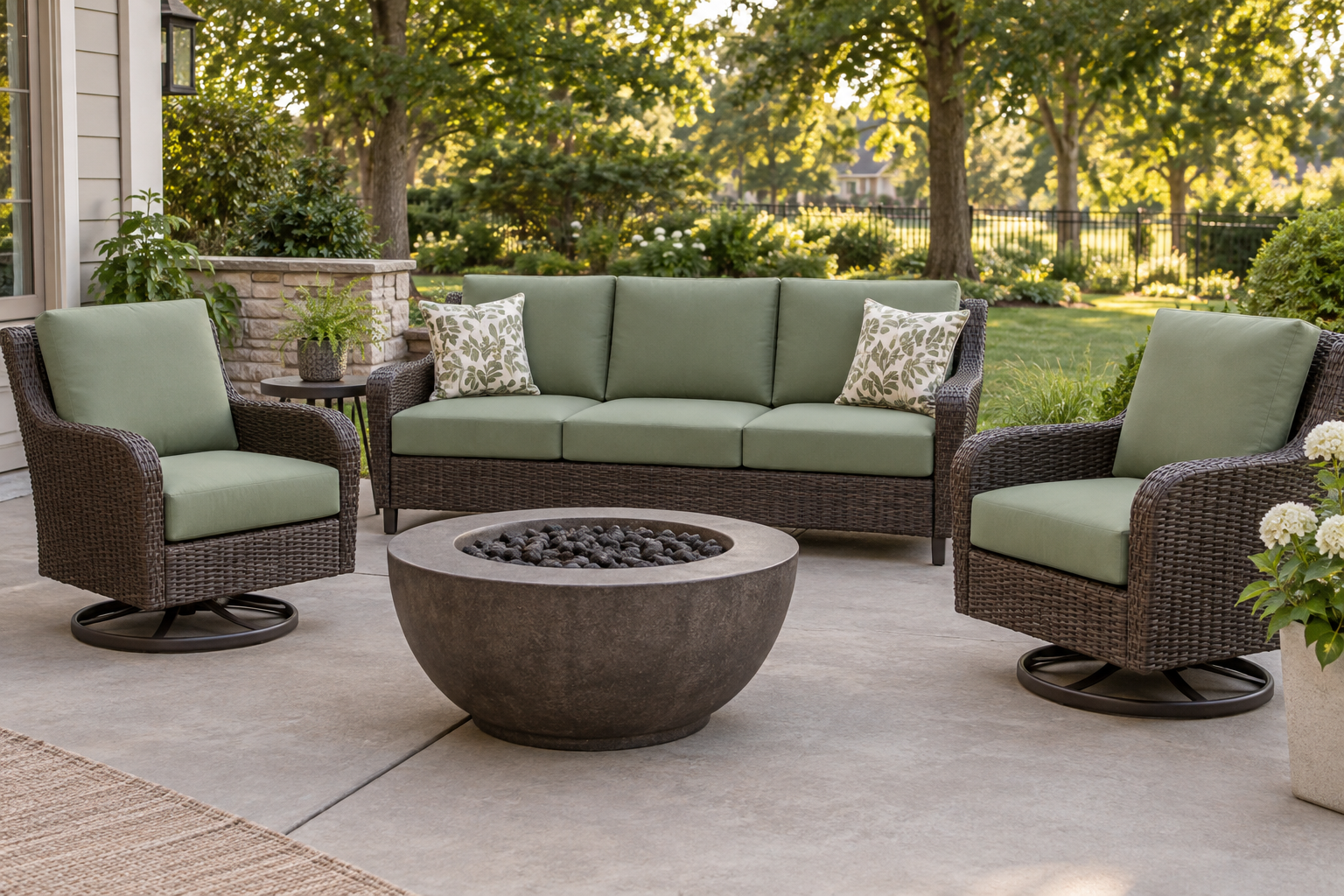
Every host knows the moment. The Hampshire set seats six in normal life, and Thanksgiving brought eleven — two on chair arms, one twelve-year-old cross-legged on a seat built for sitting, Uncle Ray perched on the edge like a man who intends to leave and never does. By ten p.m. the cushions had that flattened, stunned look. A week later, two of them still had it.
That is a load story, not a fabric story, and it has an actual physics to it — what a holiday does to foam, how much bounce-back to expect, and how to run the weekend so a set that seats six gracefully survives eleven, twice a year, for years.
What a holiday actually does to foam
Outdoor cushion foam behaves under load the way any cellular material does: sitting weight presses air out of open cells, and recovery happens as those cells re-inflate. Daily service is a gentle cycle — hours of load, then overnight rest, foam returning to shape each morning. A holiday is different in kind, not just degree. The load runs longer without relief, the weights run heavier as adults settle in for a four-hour dinner, and the loading runs weirder: edge-perching concentrates the entire body on the front third of a seat; cross-legged sitters create point loads a seat never sees in adult use; a child treating a chair as apparatus applies impacts rather than weight.
None of this is catastrophic. Foam tolerates overload well — that is its job. What ages it is overload without recovery windows, repeated. One brutal, glorious evening is a footnote. Three days of nesting without a break is where the flattening starts to accrue.
The three-phase holiday protocol
Hosts who run big weekends on the same set for a decade tend, knowingly or not, to run the same three phases:
- Before: wake the set up. Forty-eight hours ahead of the crowd, take the seats out of storage state — stand each cushion on edge an hour in the sun, press and release each seat once, and check that the foam springs back briskly. You are reading the set’s baseline so that after the weekend you can tell holiday flatten from genuine fatigue.
- During: rotate the load. Between courses or between gatherings, flip the most-sat seats to their unused twins and back — the loveseat ends swap with the rarely-sat chairs. Encourage the standing-and-mingling phase hosts secretly want anyway. Nothing about the party changes; only which foam is earning its keep at which hour.
- After: give it the recovery window. For seventy-two hours post-event, leave the set un-sat where possible, seats standing on edge overnight once. Most holiday flatten resolves in this window. On day three, do the thumb test — press hard, count seconds to full rebound. Seats that rebound are fine. A seat still holding a hollow after three restful days was already tired before the guests arrived.
When bounce-back stops being free
The permanent version of the problem announces itself honestly. A cushion that holds a visible body print after days of rest has foam whose cells have lost the fight — age and service, not one turkey dinner. At that point the cover is usually still good and the fill is the patient: a rebuild at higher density is the move, because whatever thinned the old foam will thin its same-density replacement just as surely. The density band this bench builds in runs 35D to 65D, and the honest everyday-target for a hosting-heavy set sits near 60D for seats and 50D for backs — with the knowledge that density buys resilience under load, not immunity to it.
Rebuilding the tired seats is cheaper than the set’s reputation for uncomfortable holidays suggests. Each cushion starts from a $45 make-base and climbs only with finished size and chosen density; all 119 cloths in the swatch menu carry the same figure at a given size, so re-covering the wine-stained two while refreshing the rest of the fill costs no fabric premium. Mix new and kept pieces freely — identical cloth from the same menu year over year keeps the set reading as one purchase.

Capacity arithmetic beats heroic cushions
The uncomfortable truth deserving a straight sentence: cushions are not the right tool for a seating shortage. If the guest list runs double the chair count every gathering, two folding chairs from the garage protect the Hampshire set better than any density upgrade — overflow seating is cheap, and the eleven-person dinner seated across proper chairs plus two spares is a better evening than the nine-person dinner crushed onto six seats. Design the event around the set, and the set lasts as the good dishes do.
Where the set genuinely must run hot — the family that hosts monthly — then do spend on fill, and say so on the order. The build window runs 4 to 7 business days standard and 3 to 5 rushed, with freight adding 3 to 6 weeks; a set ordered for a specific holiday wants the order in before autumn’s first leaf.
Frequently asked questions
The laundry half of the weekend belongs here too, briefly, because it is the half with a zipper in it. Every cover on a rebuild from this bench unzips completely for machine washing — the red-wine seat and the gravy boat casualty go through the machine Sunday night, not into a spot-treating queue that stretches to February. Nothing on the build is sewn shut; the panel that needs laundering is the panel that comes off. For a set whose job description includes eleven relatives, that is not a luxury feature. It is the difference between a set that recovers from hosting and a set that merely survives it, one stubborn stain at a time.
How long should holiday flattening take to disappear?
Most of it resolves overnight, and nearly all of it within seventy-two hours of rest. Give the seats that window — on edge overnight once — before judging. A hollow that survives three quiet days was not caused by the weekend; it was exposed by it, and that piece is a rebuild candidate.
How many guests is too many for a six-seat set?
Above roughly one and a half times the seat count, comfort and cushions both degrade together. Full second seating — eight or nine on six chairs — is the zone where load rotation between courses matters. Beyond that, spares from the garage are the honest answer, and your set will thank you by outliving the tradition.
Should I just order maximum density and stop worrying?
65D seats are notably firm — resilient, but a firmer sit than every-day comfort usually wants. The balanced spec for a hosting set is closer to 60D under sitting weight and 50D behind backs, chosen within the 35D to 65D range. Density improves overload tolerance; it does not repeal the need for a recovery window.
Do kids jumping off the seats actually damage the foam?
Impacts age foam faster than sustained weight does — sharp loads snap cells rather than gently pressing them. A holiday’s worth of child gymnastics is survivable; a summer of it is how seats go hollow early. A firm house rule about furniture-as-playground costs nothing and preserves the rebuild budget.
Can a rush order land before the holiday itself?
Sewing compresses to 3 to 5 business days on a rush — freight does not compress. With 3 to 6 weeks of transport on most addresses, a cushion order placed the week of the event arrives after the guests have gone home. The hosts who never sweat this are the ones who order at back-to-school time.
Two of my covers stained beyond rescue — replace the whole set?
No need. Pieces mix freely: re-cover the two casualties in the same cloth from the 119-option menu and rebuild their fill while the healthy four stay as they are, all billing from the same $45 make-base per piece. Sets age unevenly — treating them unevenly is the economical response.
What ordering from this bench gets you
One workshop, in-house start to finish — the same hands cut, fill, and sew every piece, and have for over ten years. Figures re-checked against piece count before any cloth is cut — a suspicious measurement triggers a question, not a guess. No minimum order and no stock cycle — two tired seats or the full Hampshire set, in any of 119 fabrics. Fair-build guarantee: anything outside the ±½″ tolerance (±¾″ past 36″), built to the wrong cloth or the wrong spec, gets remade at no charge.
Hampshire replacement cushions built to be leaned on by everyone you love twice a year — and to spring back for the rest of the year.
Hosting cadence unusual, or frames that confuse you at measuring time? Tell the bench the situation and we will spec it with you. Curious how rotation pairs halve the wear on a set like this? The rotation-pair page does that arithmetic — then start the order from your own measurements, with the full Hampton Bay catalog for your other series.