
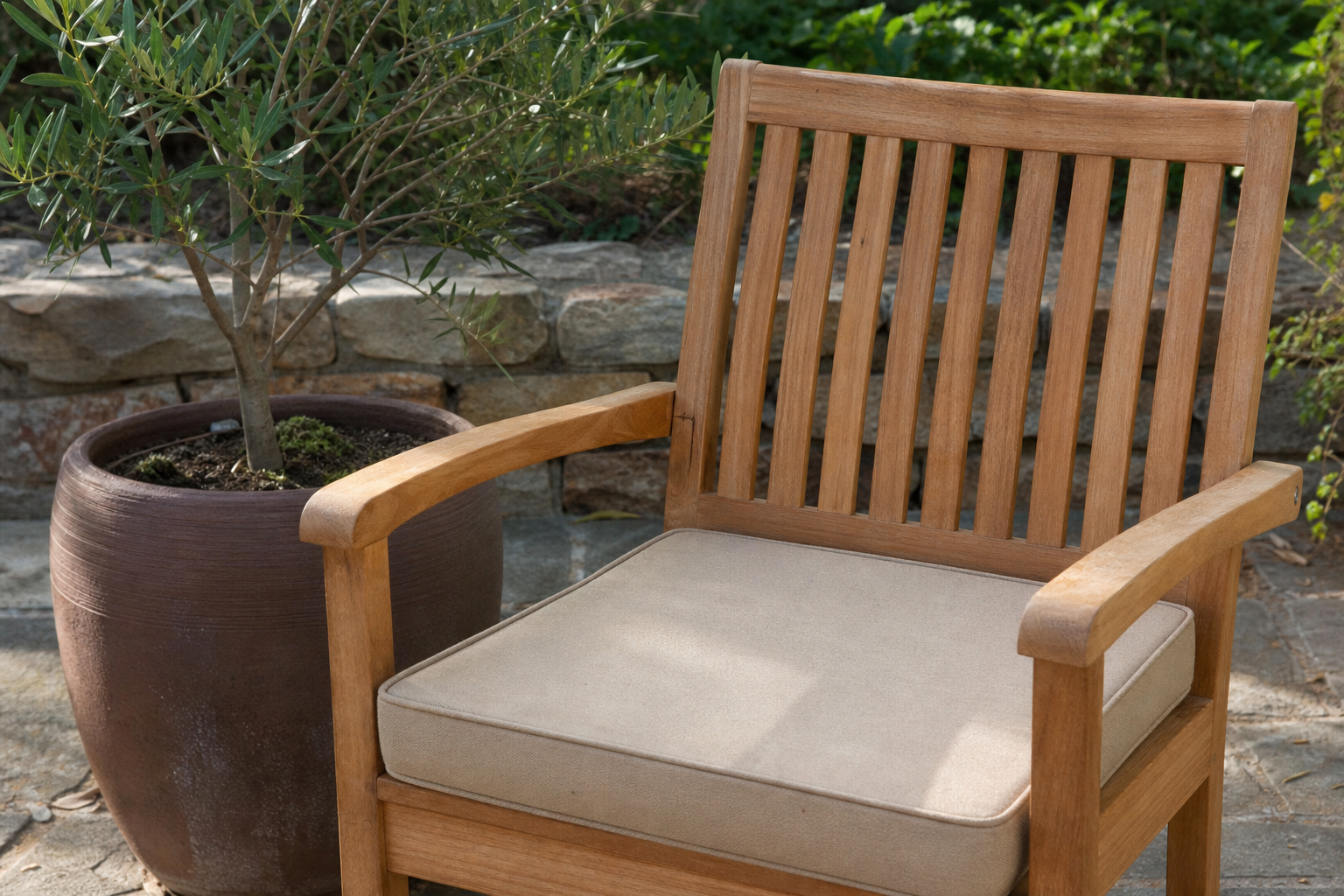
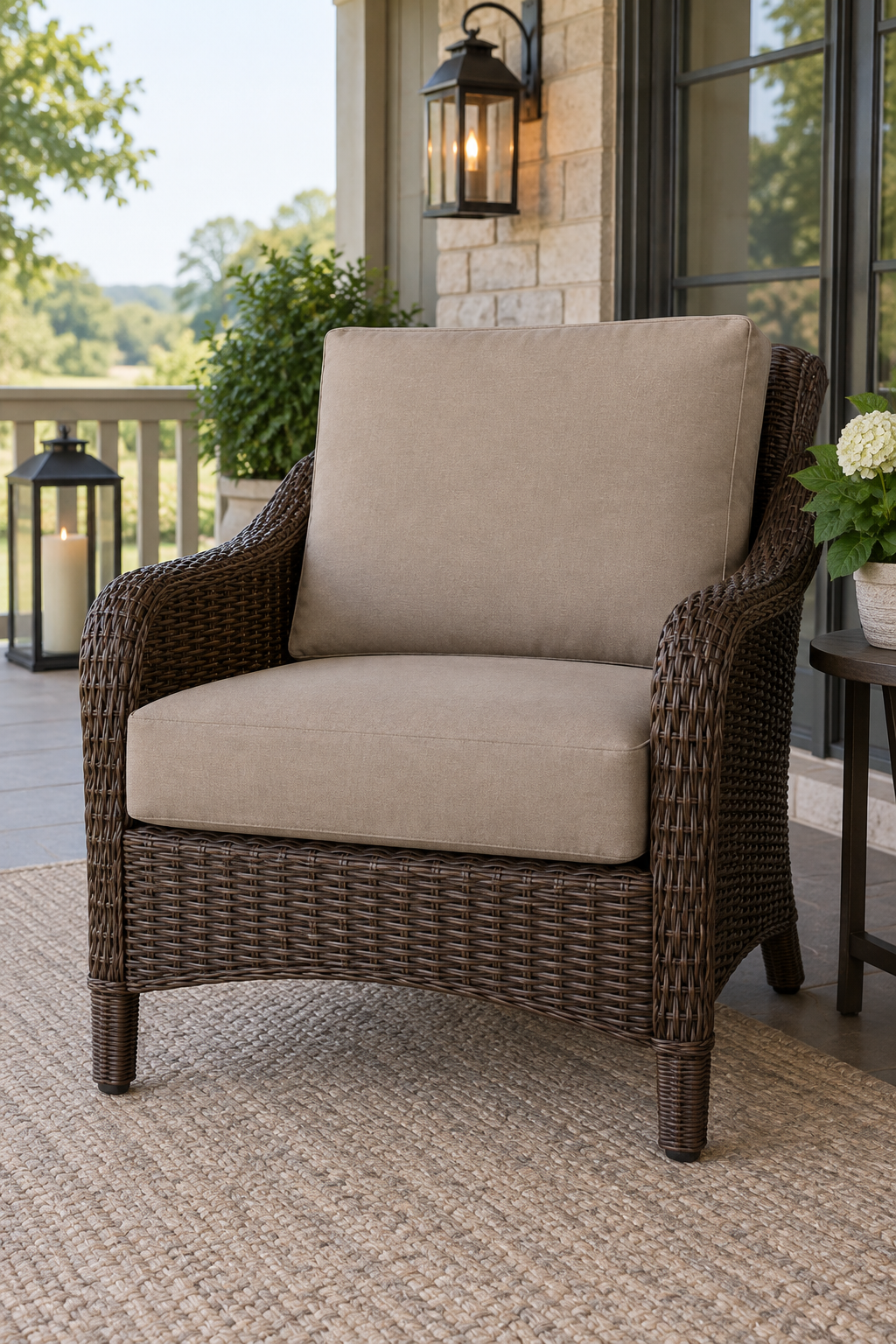
Rain does not kill cushions in one storm — it kills them a little at a time, season after season, through cycles of soaking and slow drying. If your Garborone set lives where afternoons open up without warning, this page maps what wet cycling actually does to foam and fabric, and the short daily drill that buys years back.
What repeated soak-and-dry cycles do, month by month
The first month of wet cycling leaves no visible mark — which is why the damage gets ignored. Water that soaks a cushion sits longest in the foam core, where air circulates least. A pad that dries in an afternoon on the surface stays damp inside for days. Damp foam gradually loses the open cell structure that gives it spring; each incomplete drying cycle leaves the material slightly denser, slightly lower, slightly slower to recover under a hand.
The second front is the fabric. Modern outdoor weaves shed a first rain well, but repeated saturation with slow drying invites mildew at the seams first — the stitched lines hold moisture longer than the flat panels around them. Thread is the quiet casualty: cotton-threaded seams weaken invisibly over a wet season or two, and a cover that splits along a seam line years early was usually killed by drying cycles nobody watched.
The third effect hides in plain sight: weight. A pad that has absorbed and partly retained water sags into the seat deck under its own mass, holding the frame’s contact points wet — which is how neglected cushions begin weathering the furniture underneath them.
After the season: the audit that catches slow damage
Wet seasons end, and most households simply put the furniture back to full service and forget the weather ever happened. The households that get a decade from their cushions run one short audit at the season’s turn instead. Lift each seat pad and look at what was underneath it: a deck showing water staining in the pad’s exact outline means the pad held moisture against the frame — the failure mode described above, caught in the act. Press-test the foam through the cover on every piece: a cushion that returns slowly, or holds the dent, has taken structural moisture damage that no drying recovers, and it belongs on the replacement list rather than back on the chair.
Smell is the second instrument — mustiness that survives a full wash of the cover has taken up residence in the foam itself, and foam is not salvageable once biology gets established in it. Seams get a fingertip pass: thread that feels fuzzy or breaks under a firm pinch has been cycle-fatigued and is a season from splitting. The audit takes fifteen minutes for a full set and produces a list — which pieces need rebuilding, which need only a cover wash, which frame spots need attention before the next wet stretch. Owners who run it annually replace cushions on evidence; owners who skip it replace them on embarrassment, which is a more expensive trigger and always arrives mid-party rather than at the season’s quiet edge.
Confirming the frame is a Garborone
The identification routine is short. Flip a chair and read the white tag under the seat frame — model numbers on these boxed sets usually trail a GLD or THD supplier code. No tag, then your Home Depot order history or the original assembly leaflet names the series outright. Failing both, the frame’s build (era-typical steel or wicker-over-steel construction) plus photos sent to the bench narrows the line quickly.
Series naming matters less than it seems here: Hampton Bay ran refreshes across model years, so same-name sets can carry different lofts anyway. The cushions we sew follow your own three numbers per piece — width, depth, thickness at the seam — documented in the measurement guides.
The five-minute storm drill
None of the aging above is a sentence — it is a schedule. Owners in rainy climates who get three or more extra seasons from their pads run some version of this drill:
- Before the rain arrives: pads come off the frames and move under cover or indoors. Standing them on edge in a shed or against a wall, rather than stacking flat, lets air reach the widest faces.
- After the storm: before pads go back on, tip each frame and check the seat deck for pooled water in low spots — a dry pad on a wet deck simply re-soaks from below.
- After a soaking anyway: stand cushions on edge in moving air, zipper side down-seam, and give them a full drying day. Pressing the foam through the cover tells you more than the surface does — a surface-dry pad with a damp core goes back under cover, not back on the chair.
- Weekly in the wet season: one lift-and-check of every seat, catching the pad that stayed out one night too long.
Why zip-off covers carry the season
The drill protects the foam; the cover decides whether cleaning is a chore or a wash cycle. Every cover we sew zips off the foam completely for washing — which in a rainy climate means a mildewed seam or a season’s grime is a machine cycle on gentle and an air-dry, not a lost cushion. It is standard on all our work, never an upgrade.
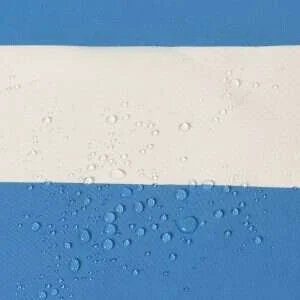
Fabric choice finishes the weather setup. Water-resistant tech fabric sheds the passing shower and wipes down after it; cotton linen rewards covered placement with the best hand; velvet holds up to indoor-outdoor traffic and claws. All 119 fabrics in the menu price identically — weather logic and color preference never compete with the budget. Each cushion starts from a $45 make-base and scales with size and the density you choose across 35D–65D, with firmer densities repaying daily-use seating in longer service life.
Neighbors on the same uncharted route: Laguna and Walnut Creek. A charted series page starts with Kampar, and the Hampton Bay hub indexes every line we track.
Frequently asked questions
A cushion got soaked and stayed out overnight — is it ruined?
One overnight soak rarely ends a healthy cushion. Stand it on edge in moving air for a full drying day, zipper-side seams facing down, and press-test the core through the cover before it returns to the frame. Damage accrues through repeated incomplete drying, not single events.
Which foam density holds up best in a wet climate?
Density and weathering are separate dials — but for seating that also sees heavy daily use, the 55D–60D band keeps its shape through years of compression cycles, while 45D–50D suits occasional pieces with a plusher feel. The full range runs 35D to 65D, priced openly as you configure.
Are the covers actually removable, or only in theory?
Removable in the practical sense: unzip, off the foam, into the machine on gentle, air-dry, back on. The zipper is our standard closure on every cushion — there is no sewn-shut tier and no hand-wash-only tier.
Do rain-exposed cushions cost more than indoor ones?
No — pricing opens at a $45 make-base per cushion and moves with size and density across 35D–65D. Every one of the 119 fabrics, including the water-resistant options, carries the same figure at a given size.
How soon can weather-ready replacements arrive?
The bench needs 4–7 business days on the standard schedule, 3–5 on a rush. Freight to most US addresses adds 3–6 weeks — so a set ordered at the start of the rainy gap arrives for the dry season, not during it.
Can I order pads for a set I cannot positively identify?
Yes — the order runs on measurements, not names. Identification mainly stops you hunting for a spec sheet that was never published, and frame photos sent to the workshop usually settle the line before cutting.
What ordering from this bench gets you
- An in-house workshop, ten-plus years deep in cutting, filling and sewing — one roof for quoting, building and shipping.
- Submitted measurements re-verified against piece count before fabric is touched — your three numbers per cushion, queried rather than guessed if something looks off.
- No minimums — replace the two pads the storm caught, or re-cover the entire set, any of 119 fabrics at flat pricing.
- Rebuild terms that are not a debate: cuts outside ±½″ of your figures (±¾″ beyond 36″), wrong fabric, wrong build — remade at our cost.
Garborone replacement cushions built for the weather they will actually meet — from a $45 make-base, dried properly, season after season.
Not sure the set is a Garborone? Upload frame photos and we will confirm first. Different line after all? Any shape, custom built — or start from the Hampton Bay index.
Shipping & Delivery
- Orders over $158 ship free — add a second cushion or an upgrade and shipping’s on us.
- Smaller orders ship anywhere in the contiguous US for one simple flat fee — always shown before you pay.
- Made in 7–14 business days. Each cushion is cut and sewn to your measurements after you order, never pulled from a shelf.
- ±½″ tolerance on all custom cuts — and if we cut it wrong, we remake it free. No forms, no fine print.
Have a deadline? Contact us before ordering and we will tell you honestly whether we can meet it.
Related products
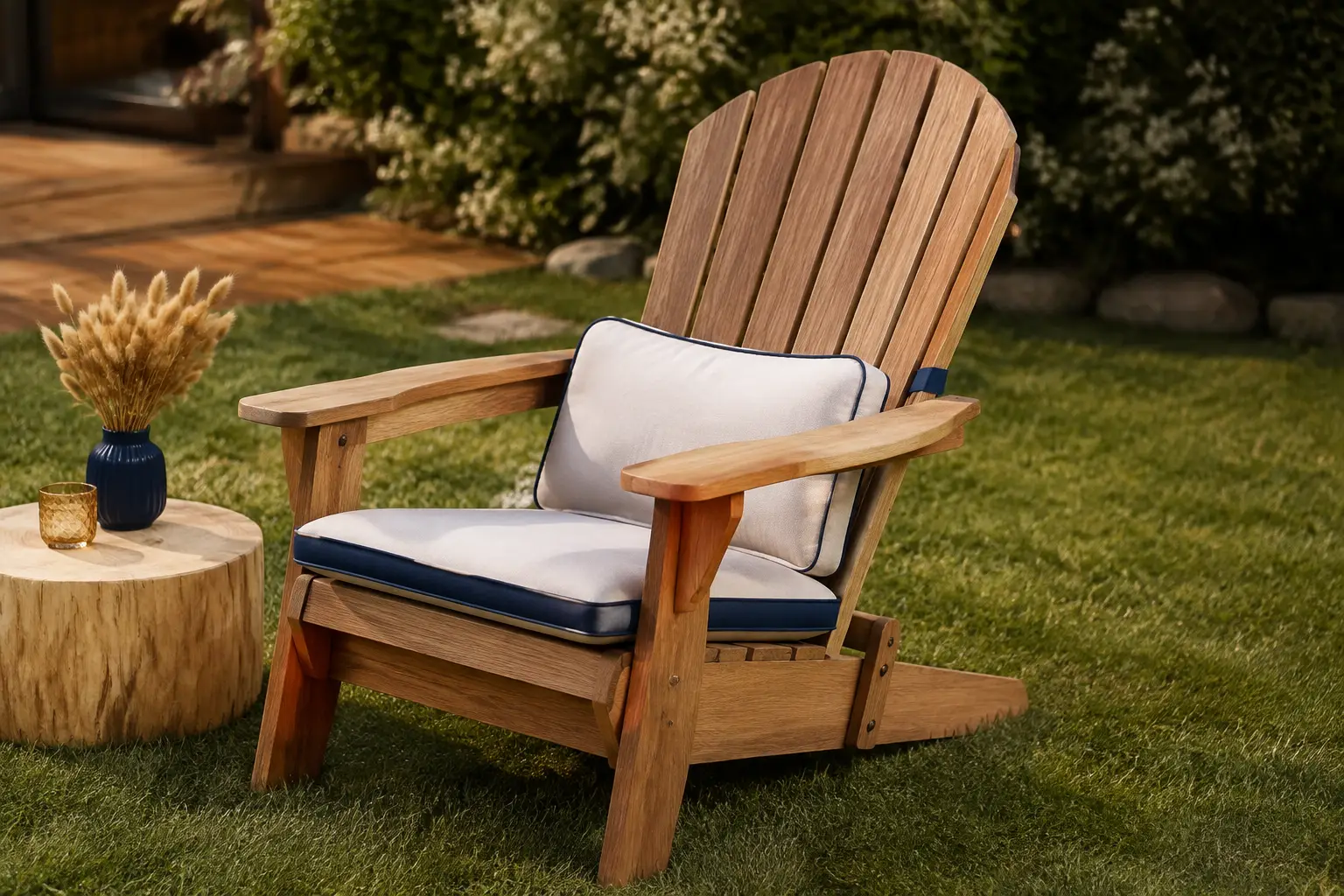
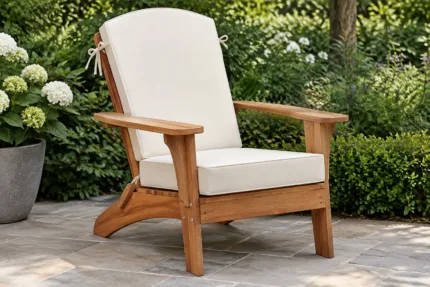
Custom Adirondack Chair Cushions
- Cut to your exact measurements — standard, oversize and vintage frames.
- 119 performance fabrics at one price — full-sun and quick-dry outdoor lines included.
- One order, one dye lot — every piece in the run ships color-matched.
- Factory-direct from $113 — instant quote in the customizer below.
- ±½″ tolerance, re-checked before cutting — remade free if we cut it wrong.
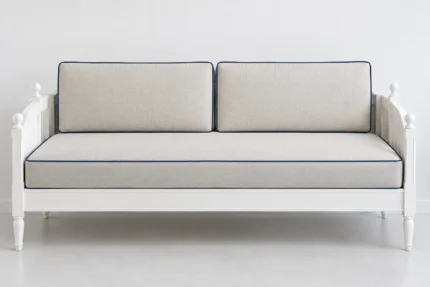
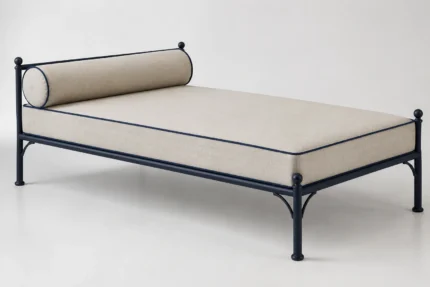
Custom Daybed Cushions
- Cut to your exact measurements — indoor daybeds, patio daybeds, cabana sections.
- 119 performance fabrics at one price — full-sun and quick-dry outdoor lines included.
- One order, one dye lot — every piece in the run ships color-matched.
- Factory-direct from $558 — instant quote in the customizer below.
- ±½″ tolerance, re-checked before cutting — remade free if we cut it wrong.

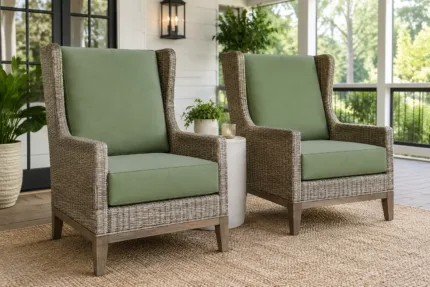
Custom Lawn Furniture Cushions
- Cut to your exact measurements — lawn chairs, swings, benches, chaises.
- 119 performance fabrics at one price — full-sun and quick-dry outdoor lines included.
- One order, one dye lot — every piece in the run ships color-matched.
- Factory-direct from $99 — instant quote in the customizer below.
- ±½″ tolerance, re-checked before cutting — remade free if we cut it wrong.
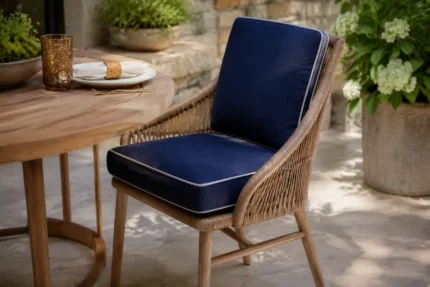
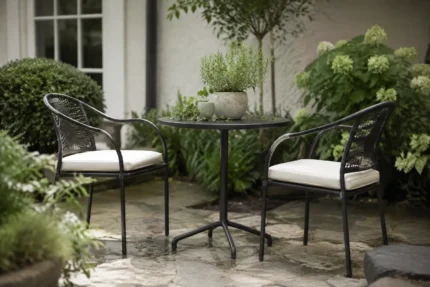
Custom Patio Chair Cushions
- Cut to your exact measurements — any patio set, any brand, any fabric.
- 119 performance fabrics at one price — full-sun and quick-dry outdoor lines included.
- One order, one dye lot — every piece in the run ships color-matched.
- Factory-direct from $106 — instant quote in the customizer below.
- ±½″ tolerance, re-checked before cutting — remade free if we cut it wrong.