
Custom Rattan Cushions for Natural Cane Frames
Factory-direct, cut to your measurements — chairs, loveseats, benches, headboards.
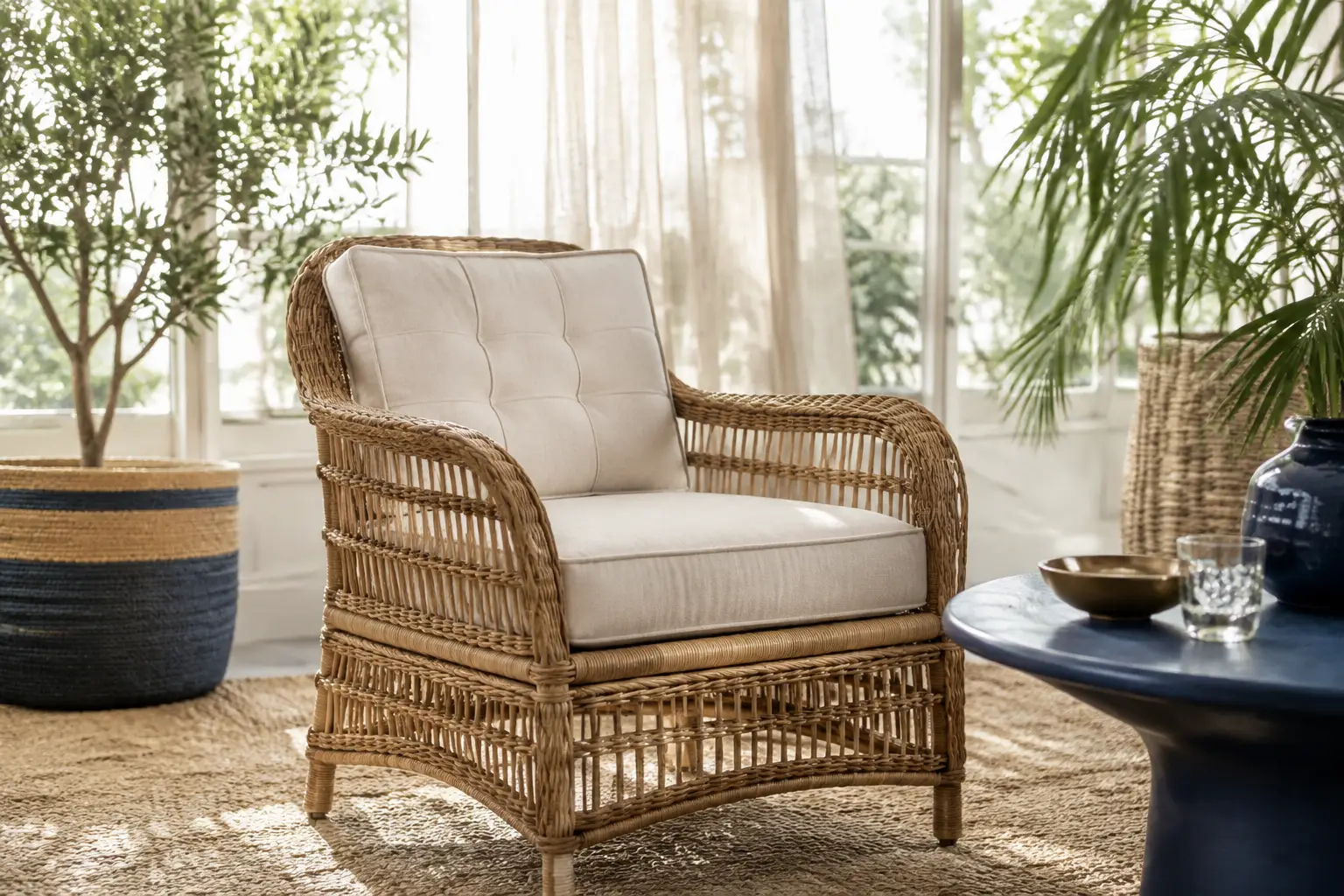
Rattan is the frame that outlives its padding twice over: steam-bent cane doesn’t squeak, splinter or rust, and the woven deck underneath breathes in a way no upholstered platform does. What fades first is everything soft — a seat flattened by decades of sunroom afternoons, a back cushion gone to lint, a bench pad that stopped matching anything years ago.
We cut rattan cushions to your frame’s numbers — dining chairs, wrapped-arm loungers, loveseats, benches, headboards — in natural cane, rattan-and-wood hybrids, and resin look-alikes too. If your South Sea Rattan, Lane Venture or Henry Link piece is wearing tired pads, the brand on the frame doesn’t limit the order: a workshop that cuts to measurements replaced the discontinued parts department the day the line retired.
Build Your Rattan Cushion
Dining squares, lounge seats, bench runs — start with the shape below.
Enter seat width and depth (front and back widths if the deck tapers), thickness, and back height — then pick your fabric tier.
Need a different shape? Start from all 11 shapes →
Pricing — estimated starting at
| Fabric tier | Estimated price* |
|---|---|
| Cotton Linen | $108 |
| Tech Fabric | $113 |
| Premium Velvet | $117 |
*One rattan lounge seat (23 × 25 × 5 in.): $39 make-base + 4.0 sq ft × rate ($17.38/$18.49/$19.62 per sq ft, 5" 50D foam + fabric). Dining squares cost less; loveseats and bench runs price per block; headboard pads price on sewn area.
For comparison: U.S. custom-configurator specialists’ 2026 listings run made-to-order cushions well above formula price once configured — and most only reveal that number after a quote request. We publish the formula above so you can check the math before you order.
The Rattan Family, Piece by Piece
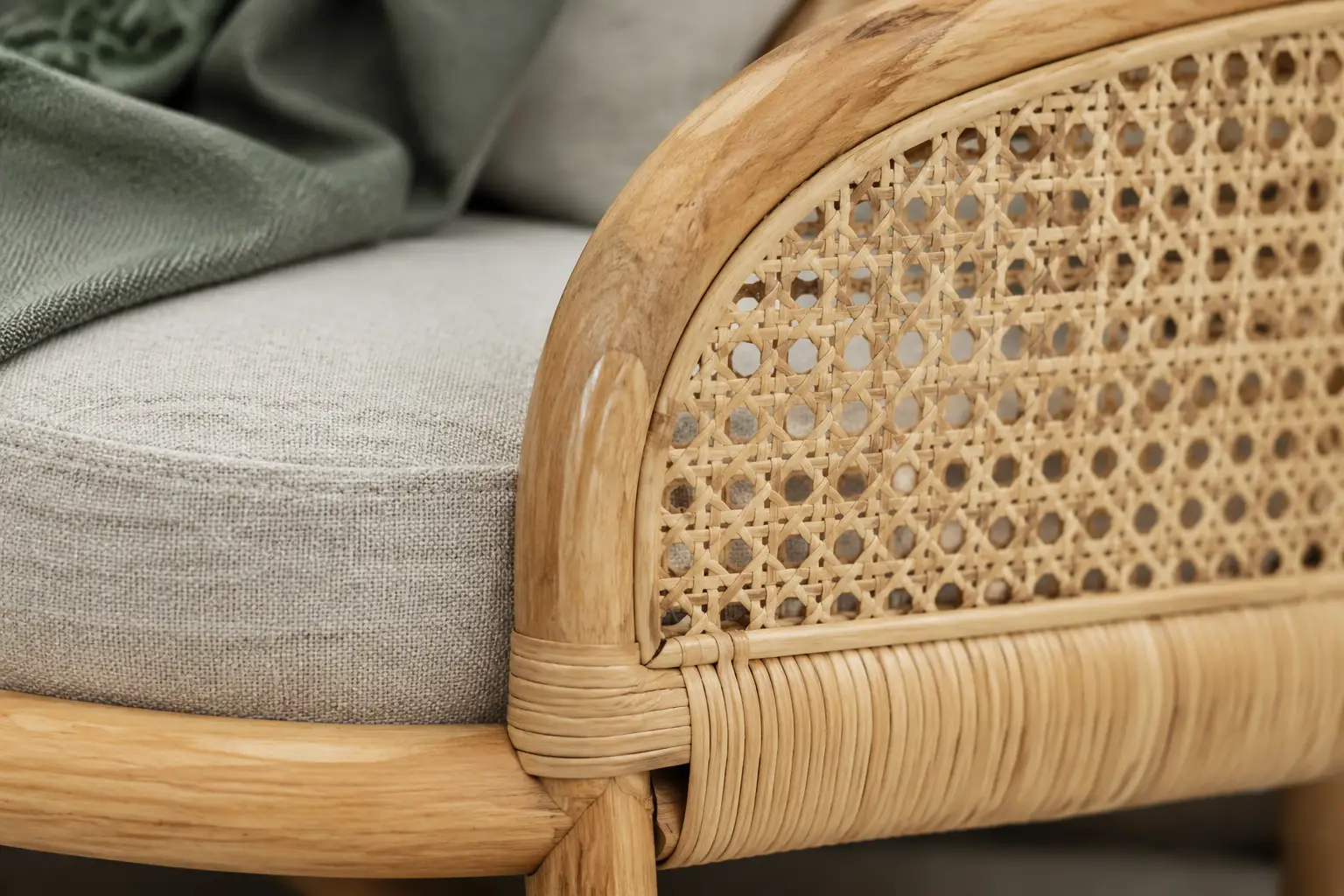
Dining and bistro chairs take thin 2–3 inch squares — the woven seat already has give, and thicker pads lift you off the table. Wrapped-arm loungers and sunroom chairs are the deep-deck end of the family: 5–6 inch seats and tall lofted backs that follow the curve the arms throw. Loveseats and settees run two seat blocks with a shared back line, and benches — hallway, sunroom, foot-of-bed — take one long run tied through the rails. The quietest job is the headboard: a full-width 2–3 inch pad that turns a woven panel into something you actually lean a morning against.
Hybrid frames are daily work here too — rattan seats on wooden legs, cane backs on upholstered bases. Whatever mix you have, the order starts from the same place: the deck, the rails, and the curve.
Common Rattan Cushion Sizes
Typical rattan cushion sizes (typical, always measure):
| Piece | Typical size | Notes |
|---|---|---|
| Rattan dining chair | 18–21 W × 18–21 D × 2–3" | Thin pad — the woven seat has give |
| Sunroom / lounge chair | 22–25 W × 23–27 D × 5–6" | Backs 18–23 H with 4–7" loft |
| Rattan loveseat | 2 blocks of 22–26 W × 23–27 D | Shared back line, separate seat pads |
| Rattan bench | 40–60 W × 17–20 D × 3–4" | Ties through the side rails |
| Rattan headboard | 38–76 W × 10–14 H × 2–3" | Full bed width — twin 38 to king 76 |
Yours differs? That’s the point — we cut to your numbers.
How to Measure a Rattan Frame
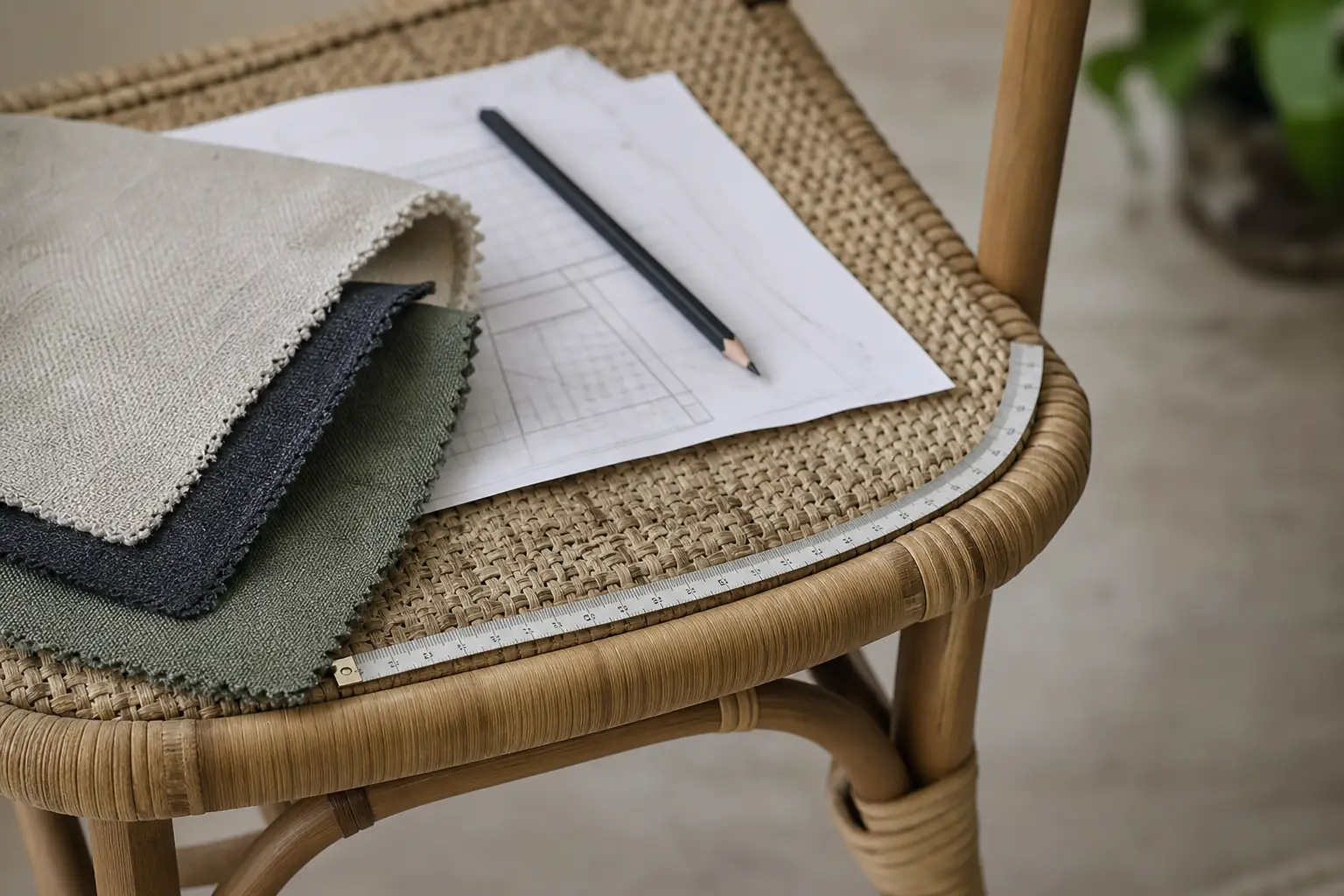
- Curved fronts want a flexible tape laid along the bow — a rigid rule bridges the curve and reads short. Record the straight-line width and how far the center of the front edge stands proud of it.
- Rounded corners: note where the weave rolls — give us the corner radius and we cut the pad to follow it; the full method is in our curved seating measuring guide.
- Wrapped-arm loungers often pinch toward the back: measure front and back widths separately, and order the trapezoid if they differ by more than half an inch.
- Ties: handwoven gaps are not evenly spaced — give tie positions measured from the deck center, not assumed at the corners.
Full walkthrough with photos: our measuring guide.
Fabric for Where the Frame Lives
Natural rattan mostly lives half in and half out — sunrooms, screened porches, covered lanais — and the fabric tier should follow the frame’s address. A reading chair in a true interior room takes any of the 119 swatches, cotton linen included. A sunroom gets real sun for part of the day, which argues for the tech-fabric tier that wipes clean and shrugs at it. A covered porch gets damp mornings, and that is where the outdoor tier earns its keep — constant damp also ages natural cane itself, so a frame living that close to the weather is worth an honest look. The fade mechanics of coated versus solution-dyed weaves are unpacked on the wicker cushions page; the short version for rattan: the cushion is the layer you replace in an afternoon, so let it take the sun instead of the frame.
Frequently asked questions
What is the difference between rattan and wicker?
Rattan is a material — the solid steam-bent stem of a climbing palm — while wicker is a technique: the weaving itself. All rattan furniture is wicker-worked, but wicker is also woven from resin, bamboo, paper fiber and reed. If your frame is honey-toned natural cane with visible bark joints, it is rattan; if it is a synthetic resin weave living outdoors, it is wicker. The cushions are cut the same way either way — the deck’s measurements, not the material name, drive the order.
Can natural rattan furniture stay outside?
Under cover, mostly yes; in the open, no. Natural cane absorbs humidity and constant sun yellows and dries the fibers, so covered porches, screened rooms and sunrooms are its range. Cushions do not change that — but on a covered frame, an outdoor-rated fabric tier buys margin against the damp mornings a sunroom still gets.
Can you match the original cushions on a South Sea Rattan, Lane Venture or Henry Link set?
We rebuild to your measurements rather than copying a factory pattern: measure the deck under the old pads, and the new cushions fit the frame the originals fit. Rebuilding pads for South Sea Rattan, Lane Venture, Henry Link and other American rattan houses is our daily work — the tape measure replaces the discontinued parts department.
Can I order standard rattan cushion sizes?
Dining squares — 19 to 21 inches — are stock-friendly, and typing those numbers into the customizer gets the same instant factory-direct quote. Lounge decks past 22 inches are where measuring earns its keep: wrapped-arm rattan frames almost never match universal pads.
Ties or anti-slip backing on a woven rattan deck?
Ties land in the weave: handwoven rattan decks have natural gaps, and ties sewn into the cushion seam thread through them — note the gap positions measured from the deck center, since handwoven corners are not always square. Anti-slip underside panels grip the weave without any gaps at all; both are build options confirmed with your dimensions.
What cushion thickness do rattan chairs take?
Dining and bistro rattan chairs take 2–3 inches — the woven seat itself has give, and a thicker pad lifts you off the table height. Lounge and sunroom chairs take 5–6 inch seats with lofted backs, matching the deep decks wrapped-arm frames are built with.
Made by the factory that ships them
- Outdoor cushion factory for 10+ years — we cut, fill, and sew every order ourselves.
- Every dimension you send is re-checked before a single yard of fabric is cut.
- Made-to-order means any fabric, any piece, no minimum.
- Cut to ± ½ inch of your confirmed dimensions, in writing — outside tolerance, remade free.
Related categories
- Wicker Cushions — resin-weave frames and full weather duty; the word-family split, explained there
- Deep Seat Cushions — the sizing logic for 23–27 inch decks
- Bench Cushions — long runs, ties and hinged lids
Further reading from the blog
- Wicker furniture cushions: the complete guide — sizes, selection and replacement across the weave family
- How to measure curved wicker seating — bowed fronts and radius corners, the method this page leans on
- The outdoor fabric guide — tier-by-tier comparison for frames that live near the weather
