
Custom Couch Cushions & Replacement Foam Cores
Factory-direct, cut to your measurements — refill the cores, recover the set, or rebuild every block.

A couch rarely wears out all at once. The frame holds for decades, the fabric fades unevenly, and one evening a seat stays dished no matter how firmly you plump it. That dent is the foam core giving up — and it is why most couches hauled to the curb still had years of sitting left in them. What died was a replaceable layer.
We cut couch cushions to your measurements — replacement foam cores for covers that are still sound, full seat-and-back sets when both layers are done — in 45–60D foam, every piece in one production run so the blocks match in loft and fabric lot. The frame’s model number never comes up: discontinued, hand-me-down and no-name couches are all the same to a tape measure.
Build Your Couch Cushion
Seat blocks, T-cushion decks, back cushions — start with the shape below.
Enter each seat block’s width and depth, thickness, and back height — then pick your fabric tier and order the set in one run. Foam-only refills skip the customizer: measure the old core and order by cut size.
Need a different shape? Start from all 11 shapes →
Pricing — estimated starting at
| Fabric tier | Estimated price* |
|---|---|
| Cotton Linen | $108 |
| Tech Fabric | $113 |
| Premium Velvet | $117 |
*One couch seat block (24 × 24 × 5 in.): $39 make-base + 4.0 sq ft × rate ($17.38/$18.49/$19.62 per sq ft, 5" 50D foam + fabric). Three-seat couches are per-block multiples; back cushions price on their own area.
Refill lane: foam-only cores cut to your measurements price at foam rates — $6–7 per sq ft at 4–5 inch 50D — with no make-base, because we are not sewing a cover.
For comparison: U.S. custom-configurator specialists’ 2026 listings run made-to-order cushions well above formula price once configured — and most only reveal that number after a quote request. We publish the formula above so you can check the math before you order.
Refill, Recover, or Rebuild: Reading a Worn-Out Couch
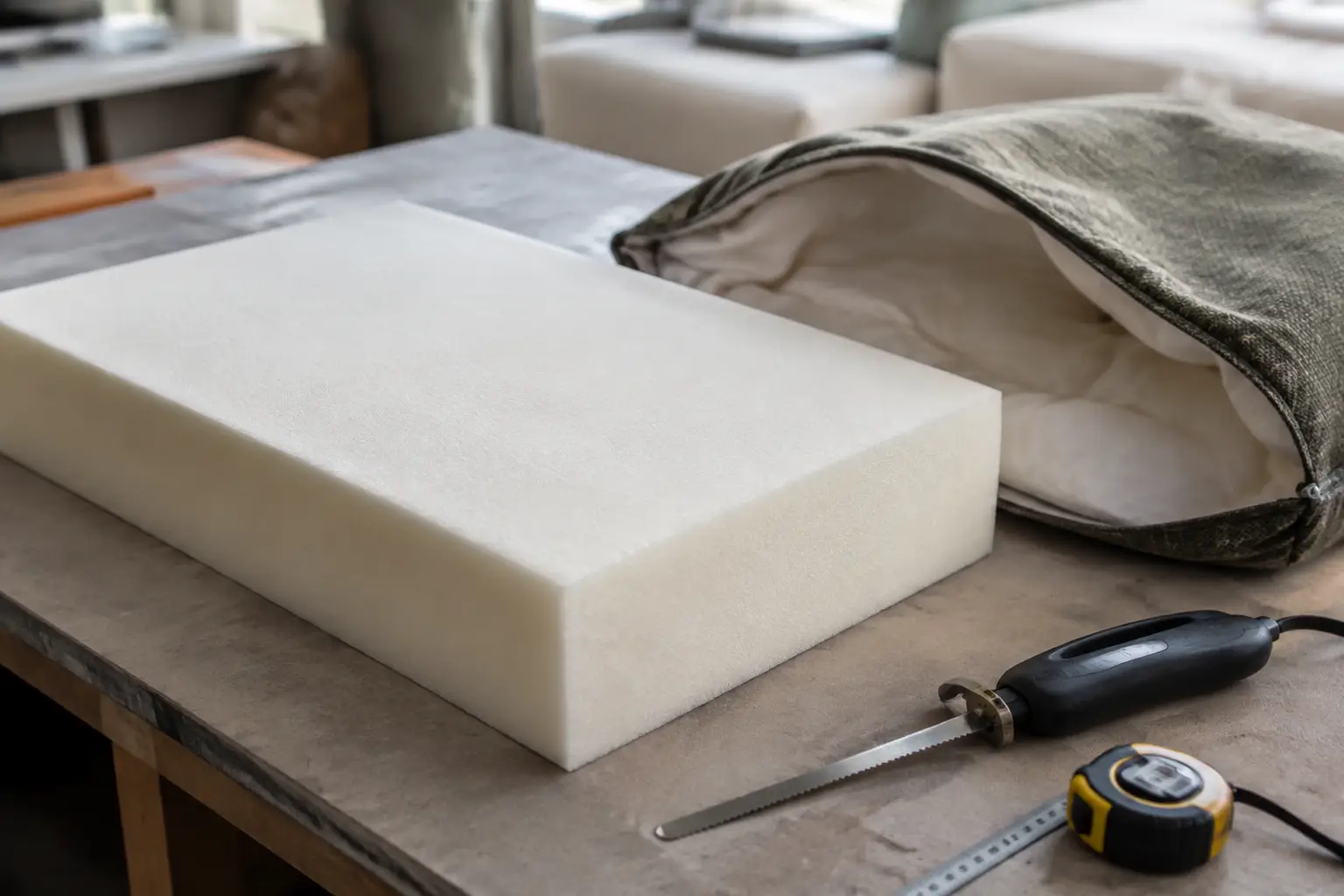
Before you order anything, find out which layer actually died. Unzip a cover and the couch tells you itself.
The refill lane — new cores, sound covers
If the fabric is still tight — seams intact, zipper working, color you still like — and the seat stays dished, the foam is the only casualty. Replacement foam cores are cut to your measurements at foam rates, no make-base. Measure the old core flat: width, depth, and thickness at the center, never at the crushed front edge. Baggy old covers mislead — measure the cover’s interior seam to seam and subtract up to half an inch, so the fresh foam fills the cover snug without fighting the zipper.
The recover route — sound cores, tired fabric
Sometimes it runs the other way: the seat still sits firm, but the fabric is sun-faded on the window side, clawed at one arm, or torn at a single seam. New covers sewn to your cushion’s measured outline give the set another decade without touching the core — the full method is in our covers guide.
The full rebuild — when both layers are done
Pads from a few decades back are usually both at once: foam crumbled inside, fabric past recovering. Then you measure the deck itself and rebuild every block in one production run.
Common Couch Cushion Sizes
What a typical couch breaks down into (typical, always measure):
| Piece | Typical size | Notes |
|---|---|---|
| Loveseat (2 blocks) | 2 × 20–23 W × 21–24 D × 4.5–5.5" | Sometimes one joined 44–48" deck instead |
| Standard couch (3 blocks) | 3 × 20–25 W × 21–25 D × 4.5–5.5" | Count blocks before measuring — makers vary |
| Apartment couch | Narrower 19–22 W blocks | 60–72" frames, often no center block |
| T-cushion seats | Seat runs forward under each arm | The notch is the dimension people miss |
| Back cushions | Match seat W × 18–22 H | Usually fiber-filled; counted separately from foam seats |
Match the original thickness when refilling — a thicker core changes seat height and how the back cushions lean against it.
Yours differs? That’s the point — we cut to your numbers.
How to Measure Couch Cushions
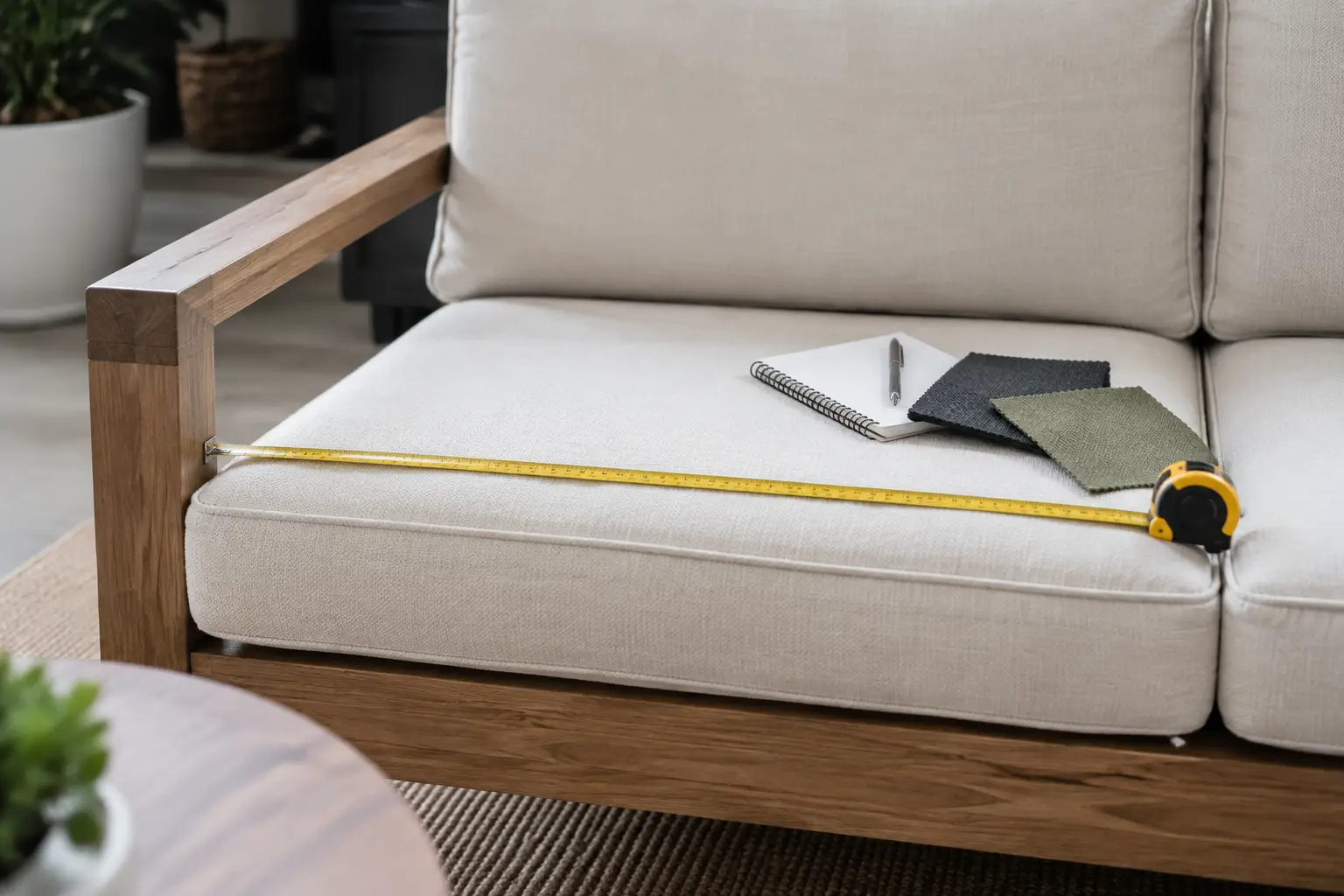
- Rebuilding? Measure the deck the pad sits on, seam to seam to the nearest quarter inch — the old pad has sagged into a shape of its own and will lie to you.
- Refilling? Measure the old core, or the cover’s interior with the zipper open — the refill sizes to the cover, the rebuild sizes to the frame.
- T-cushion arms: sketch the notched outline with every dimension labeled — the full method is in how to measure a T-cushion sofa.
- Adjacent seat blocks should match within a quarter inch, or the joins show every time someone stands up.
Full walkthrough with photos: our measuring guide.
Indoor Fabric for the Couch You Actually Sit On
A refill leaves the old cover in place, so fabric is the decision on the rebuild and recover lanes. Choose by how the couch lives, not how the showroom looked: cotton linen for the breathable natural weave that only gets softer with use; premium velvet for formal rooms and the honest truth about claws; tech fabric where a dog and two kids hold permanent claims on the seat. Every fabric in the 119-swatch library ships free samples with each quote — order them before you commit, because a navy that reads as slate on screen will not negotiate once it is sewn. The tier-by-tier comparison is in the covers guide.
Frequently asked questions
How much do replacement couch cushions cost?
Three lanes, three levels. Foam-only refills run $6–7 per sq ft at 4–5 inch 50D with no make-base — a 24 × 24 seat core lands in the double digits. Full replacement cushions run $39 make-base plus area, about $108–$117 per 24 × 24 × 5 seat block by fabric tier, so a three-seat couch with backs lands in the mid hundreds. All of it a fraction of re-upholstery or a new couch.
How do I know if my couch needs new foam or new cushions?
Unzip and look. Cover fabric tight, seams intact, seat dished — the foam died; order cores. Seat still firm, fabric faded or torn — recover the set. Foam crumbling and fabric past saving — rebuild both layers in one run. The dent test: a seat that stays dished after fluffing has compressed foam, and compressed foam does not rebound.
What foam density should replacement couch cushions be?
Match or upgrade from the original — factory couches often ship on light grades, which is why the seat died in five years. 45D serves a guest room; 50D is the floor for the couch the family actually lives on; 60D for heavy daily duty. Density buys years, and the front edge of the seat is where light foam fails first.
Should the new foam core wear batting?
If the old core wore a batting jacket — a thin fiber wrap around the foam — replace it with the core. Batting rounds the square edge of cut foam, softens the sit, and takes the abrasion that would otherwise reach the cover seams. Match what came out of the cover: wrapped cores if the old jacket was doing its job, bare if the cover has its own lining.
Can I replace just one seat block on a couch?
You can, with two caveats. The new block will sit prouder than its flattened neighbors for the first months, and fabric cut from a different lot can read a half-tone off the old covers in daylight. If more than one block is dead, ordering the set in one production run avoids both.
What’s the difference between custom and replacement couch cushions?
Nothing in the process, everything in the starting point. Custom starts from your frame’s deck measurements for a new build; replacement starts from the old cushion’s outline to rebuild what was there. Either way the cut is to your numbers — which is why both words land on pages quoting the same formula.
Made by the factory that ships them
- Outdoor cushion factory for 10+ years — we cut, fill, and sew every order ourselves.
- Every dimension you send is re-checked before a single yard of fabric is cut.
- Made-to-order means any fabric, any piece, no minimum.
- Cut to ± ½ inch of your confirmed dimensions, in writing — outside tolerance, remade free.
Related categories
- Custom Sofa Cushions — the same factory’s new-set page; sofa and couch words split between the two
- Loveseat Cushions — two-seat blocks and joined decks
- Settee Cushions — the refill-vs-rebuild math at smaller frame scale
Further reading from the blog
- Where to buy replacement couch cushions — every channel compared, the buying article behind this page
- Sofa foam cut to size — ordering exact-fit cores, the refill method
- How to replace sofa cushion foam — the DIY swap, step by step
- Replacement cushion covers guide — the recover route in detail
- How to fix sagging couch cushions — foam, not fluff
- High density foam couch guide — what density actually means
- How to measure a T-cushion sofa — arms, wings and the notches that trip up tape measures
