
15" x 15" Seat Cushions – Custom Made to Your Exact Size
Cut to your measurements — width, depth, and thickness — not to a stock chart. Factory-direct, no minimums.
The 15-inch square is small-seat country: kitchen stools, folding chairs, piano benches, garden seats, and kids’ chairs. Small squares are where stock sizing is sloppiest — a “15 inch” retail pad can measure anything from 14 to 16 — and where a quarter inch of accuracy shows most. We cut to your number.
Every 15 x 15 seat cushion is cut to the measurements you send — width, depth, thickness. Two inches keeps a stool at counter height; 3″ suits a bench you linger on. Fabric tiers start with Cotton Linen, a durable everyday weave with no pilling, shrinking, or fading; Tech Fabric, the waterproof, wipe-clean leather-like workhorse; and Premium Velvet, plush claw-resistant velvet for indoor luxury — the same tiers as our full-size lines, because sun through a kitchen window fades fabric too. Covers close with a sewn envelope closure — spot cleaning keeps small pads fresh without unzipping anything.
Pricing — estimated starting at
| Fabric tier | Estimated price* |
|---|---|
| Cotton Linen | $69 |
| Tech Fabric | $79 |
| Premium Velvet | $93 |
*One cushion, 15 × 15 in. (1.56 sq ft top surface): $39 make-base + 1.56 sq ft × fabric rate ($19.0/sq ft, $25.5/sq ft, $34.0/sq ft). Thickness, foam density, and the sewn closure is confirmed at checkout — and every dimension is confirmed with you before we cut.
For comparison: U.S. custom-configurator specialists’ 2026 listings for made-to-order cushions in common sizes (16×16 through 24×24) run roughly $71–$119 before shipping — and most only reveal that price after a quote request. We publish the formula above so you can check the math before you order.
What fits a 15 x 15 cushion?
No factory-original cushion in our measurement library lands within ¾″ of this size yet — which makes a 15 x 15 a true custom order, and custom orders are our whole business. Measure your old cushion flat (edge to edge, seam to seam), or measure the seat deck between the frame rails, and send us the numbers. We cut to whatever you measured — the quarter inch included — in any fabric tier, any thickness, one piece or a full set.
Start a Custom 15 x 15 Order → or walk through How to Measure first.
The measurement library holds no factory-original at this exact square — brand-name patio lines rarely cut seats below 16 inches, which tells you something useful: a 15 x 15 deck is usually a stool, a vintage chair, or an imported set whose cushions were never catalogued anywhere. The closest documented squares in our charts sit at 16 x 16 and up (see the 16 x 16 page and the replacement library), and any of them can be ordered a fraction smaller — the cutting table does not know the difference between a stock number and your number.
Measuring tips for a 15 x 15
- Old cushion flat on a table: width edge to edge, depth front to back, thickness seam to seam — never squeezed.
- No old cushion? Measure the seat deck between the frame rails and arms, and send the raw numbers rather than rounding.
- Photograph the label under the frame first — a model number can match you to a documented series chart in seconds.
Full walkthrough with photos: How to Measure (and Identify) Your Cushions.
More measuring help: How to measure radius corners · 9 cushion measurement mistakes that cause remakes
Foam thickness for a 15 x 15
Fifteen-inch squares live almost entirely on stools and small chairs, where thickness is arithmetic: counter stools sit 24–27 inches high and bar stools 28–32, so every inch of cushion is an inch of knee clearance under the counter lip. Two inches where the gap is tight, 2.5–3 where the chair is for sitting rather than perching. Kids’ chairs flip the logic — a thicker pad is often the point, buying a growing child another year at the big table.
On foam, the honest spec at this size is 35D for occasional seats and 50D for the stool that hosts every morning coffee; density is what separates the pad that recovers for years from the one that dishes where you always sit. All four grades, 35D–65D, are available — confirmed with your dimensions before cutting.
Fabrics that suit a 15 x 15
Small squares take the same three tiers as every other size we cut. Kitchen and bar stools gravitate to Tech Fabric — waterproof and wipe-clean, which matters directly above a floor that sees spills. Cotton Linen suits covered porches and low-spill dining rooms, and Premium Velvet takes formal dressing stools and cat-adjacent seating. Because the footprint is small the tier difference is a few dollars per pad — worth choosing on lifestyle, not budget. The full comparison is in the outdoor fabric guide.

Cabana Stripe Canvas · Gray

Cabana Stripe Canvas · Blue
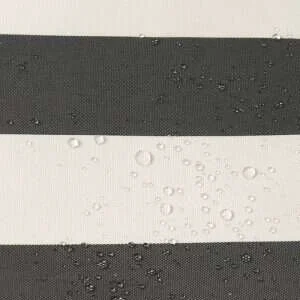
Cabana Stripe Canvas · Gray
From the 119-fabric swatch library — free samples ship with every quote.
Frequently asked questions
What thickness for a 15 x 15 stool cushion?
2″ for counter stools where height matters; 2.5″–3″ for chairs you sit in longer. Every inch of cushion is an inch of seat height.
Are these indoor or outdoor cushions?
Both — you choose the fabric tier. Cotton Linen, our durable everyday weave, for kitchen use; Tech Fabric, the waterproof, wipe-clean leather-like workhorse, for garden and patio seating.
Can I get high-density foam at this size?
Yes — recommended for daily-use stools. Standard foam feels fine for occasional seating and bottoms out under daily use.
Will a 15 x 15 cushion fit a standard bar stool?
Measure the deck, not the label: most bar stools run 13–16 inch round or square decks, and 15 x 15 covers many of them — but stool decks vary more than any other seat class. Measure edge to edge to the nearest quarter inch; a pad cut to your numbers beats a label every time.
Can I get 15 x 15 pads for a whole counter set?
Yes — per-stool numbers in one order, one fabric run, matching dye lots. If two stools differ by a quarter inch (common on swivel stools worn unevenly), give each its own line item; the price formula does not charge extra for precision.
What’s the difference between counter and bar stool cushions?
Height, mostly — counter stools sit under 36-inch surfaces and bar stools under 40–42, so the clearance under each sets the thickness ceiling. A 15 x 15 pad at 2 inches works at both; the same pad at 3.5 clears a bar and collides with a counter. Measure the overhang with a sitter before picking thickness.
15 x 15 on stools, counters, and bars
Small squares live at three heights, and the height — not the footprint — is the real specification. Kitchen counter stools sit under a 36-inch counter; bar stools sit under a 40–42 inch bar; backless task and vanity stools sit wherever they were put. Each height was designed around a pad thickness, and every inch of cushion is an inch of seat height: two inches keeps a counter stool under its counter, and the same stool at four inches puts the sitter’s elbows at chin level. Measure the deck, then measure the clearance under the counter’s overhang with someone sitting — the second number sets the thickness ceiling.
Deck shape matters more here than anywhere: 15-inch decks run squares, rounds, and squares-with-rounded-corners, and swivel stools wear unevenly enough that two “identical” chairs can differ by a quarter inch. Per-stool line items in one order solve it — same fabric run, each pad to its own numbers.
